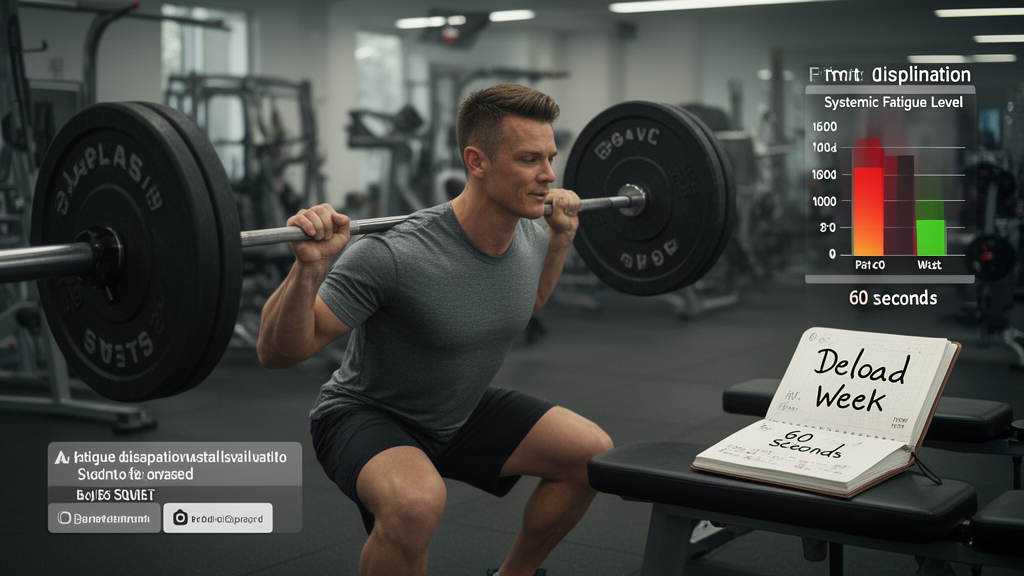
Quick answer: after poor sleep, extend rest by roughly 30 to 60 seconds and reduce load or volume rather than pushing through. Sleep deprivation impairs force output, motivation, and recovery between sets simultaneously, so the same rest buys you less than it usually would.
Poor sleep is the most common unaddressed performance variable in recreational strength training. Athletes carefully track sets, reps, progressive overload, and rest periods — and then train on 5 hours of sleep without adjusting a single programming variable. The result is sessions where performance appears to plateau or regress for reasons that seem mysterious. The science of sleep and neuromuscular recovery reveals a direct mechanism: sleep deprivation elevates baseline CNS fatigue and reduces the efficiency of the recovery processes that happen between sets.
Sleep and the Central Nervous System
The glymphatic system is a brain-specific waste clearance network that operates primarily during deep sleep. During slow-wave sleep stages, the interstitial space in brain tissue expands substantially, allowing cerebrospinal fluid to flush metabolic byproducts — including adenosine, inflammatory cytokines, and metabolic waste from neuronal activity — out of the central nervous system.
Adenosine is particularly relevant for strength training. Adenosine is the primary fatigue signal in the CNS; it accumulates during waking hours and training, creating the sensation of tiredness and reducing neural drive. Sleep clears adenosine. When sleep is insufficient, residual adenosine from the previous day persists into the next training session, elevating the CNS fatigue baseline before the first warm-up set begins.
Practically, this means that a lifter training on poor sleep starts the session with a central nervous system that is already partially fatigued. The same progressive fatigue that accumulates across a full session happens faster against a higher baseline. Sets that would normally feel manageable at the 60-minute mark of a well-rested session may feel maximal at the 30-minute mark on poor sleep.
For a foundational explanation of CNS fatigue mechanisms, see CNS fatigue explained.
What Research Shows About Sleep-Deprived Strength Performance
Studies on acute sleep deprivation — typically one night of restricted sleep — consistently show reductions in maximal voluntary contraction force of 3 to 8%, velocity of bar movement across the range of 5 to 12%, and total volume completed before subjective failure. These effects are present even when motivation and perceived readiness feel relatively normal, because sleep deprivation impairs self-assessment of fatigue status.
Chronic sleep debt — the accumulation of multiple nights of insufficient sleep — produces larger deficits than a single bad night. A week of sleeping 6 hours per night produces neuromuscular performance decrements comparable to one night of total sleep deprivation. This non-linear accumulation means that athletes who consistently sleep 6 hours may be operating with substantially greater deficits than they perceive.
Grip strength is a reliable sensitive indicator of sleep-related CNS fatigue — the same marker discussed in the article on grip strength loss and CNS fatigue. When grip strength tests below your normal baseline before training, sleep quality is a likely contributor.
The Cumulative Fatigue Problem
One bad night produces a recoverable deficit. Chronic sleep restriction produces a cumulative deficit that normal training cannot overcome.
The threshold at which one night of poor sleep requires a meaningful rest period adjustment is roughly fewer than 6 hours. Below this level, the adenosine residual and inflammatory baseline are elevated enough to produce measurable performance effects within the training session. A single night of 5 to 6 hours of sleep may warrant extending rest periods by 30 seconds across all presets and reducing top-set intensity by 5 to 10%.
Chronic sleep debt — multiple consecutive nights below 6 hours — requires a larger response. Extending rest by 60 seconds, dropping intensity by 10%, and reducing total session volume are all appropriate responses. Training at full intensity and volume on chronic sleep debt provides less stimulus than the numbers suggest because set quality degrades, motor patterns become imprecise, and injury risk increases.
Practical Adjustment on Poor Sleep Days
For training sessions following fewer than 6 hours of sleep:
- Extend all rest periods by 30 seconds. The 90-second preset becomes 2 minutes; the 2-minute preset becomes 2 minutes 30 seconds; the 3-minute preset becomes 3 minutes 30 seconds.
- Reduce working set intensity by 5 to 10% on primary lifts.
- Stop sets at rep targets rather than extending to technical failure, because technique degrades faster under sleep-deprived CNS fatigue.
- Prioritize the main lift and reduce accessory volume if session energy deteriorates.
For sessions following chronic sleep debt — multiple consecutive nights of poor sleep — the better choice may be to train at 60 to 70% intensity with full rest periods rather than attempting the programmed session. The stimulus-to-fatigue ratio of a high-effort session on sleep debt is unfavorable; a lighter technical session preserves the habit without adding unproductive systemic stress.
For guidance on managing training across different energy and recovery states, the timer quick start page allows easy rest period customization per session.
When Not to Train
The signs that sleep debt has become a health risk rather than a performance variable include persistent resting heart rate elevation above baseline, morning soreness that does not clear through the day, consistent mood disturbance or anxiety, impaired cognitive function during the training session, and dizziness on exertion. These signs indicate systemic under-recovery where training adds to the problem rather than contributing to adaptation.
Rest-period optimization cannot compensate for systemic under-recovery. At this level, the intervention is sleep, not longer rest periods.
The relationship between sleep quality and training age also affects athletes over 40 specifically — see rest periods over 40 for age-specific guidance.
Sleep also drives the hormonal side of recovery, discussed in rest periods and testosterone.