Quick answer: central nervous system fatigue is a reduction in your brain and spinal cord’s ability to drive muscle fibers at full intensity. It shows up as heavy-feeling warm-up weights and missed reps at loads you normally handle, and it recovers more slowly than the muscle itself, typically over 2 to 4 minutes between sets and days between heavy sessions.
The Science: Central Nervous System Fatigue Symptoms and Rest Periods
You walk into the gym feeling strong. You crush your first heavy set of squats. But by the third set, the weight feels twice as heavy. Your legs are not sore, but the bar refuses to move at speed. This is the hallmark of central nervous system fatigue symptoms and rest periods that haven’t been long enough to allow for neural rebooting.
Calcium-Ion Resynthesis and Neural Drive
To understand why the CNS fails, we must look at the interface between your nerves and your muscles.
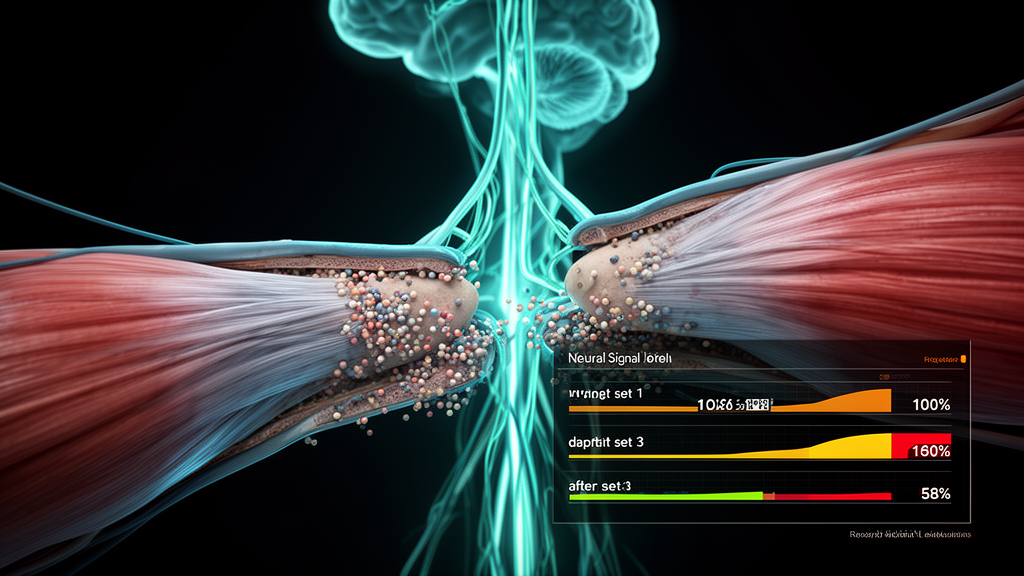
- Neurotransmitter Depletion: For a muscle to contract, your brain must release Acetylcholine at the neuromuscular junction. High-threshold efforts can deplete these levels, weakening the electrical “bridge” between the intent to lift and the actual contraction.
- Calcium-Ion Accumulation: Muscle contraction relies on calcium ions moving in and out of the sarcoplasmic reticulum. During repeated bouts of high intensity, this transport system becomes sluggish. Even if your brain sends a loud signal, the muscle fibers cannot respond because they are “swamped” with signaling molecules.
- The Resulting Signal Loss: This is not just “feeling tired.” It is a measurable drop in neural drive. Research shows that while metabolic waste clears in 2 minutes, this neural interface can take 5 to 7 minutes to return to 100% efficiency.
For maximal lifts above 85% of your one-rep max, this signal must be incredibly loud. The “driver” is flooring the gas pedal.
The Signal Fades
After a maximal effort, the driver gets tired. The ability of your brain to send that high-frequency signal diminishes. This is known as central fatigue.
Your muscles might have plenty of fuel left. But if the signal from the brain is weak, the muscle will not contract with full force. You are pressing the gas pedal, but the car is not responding.
How Long Does It Last?
This is where most lifters get it wrong.
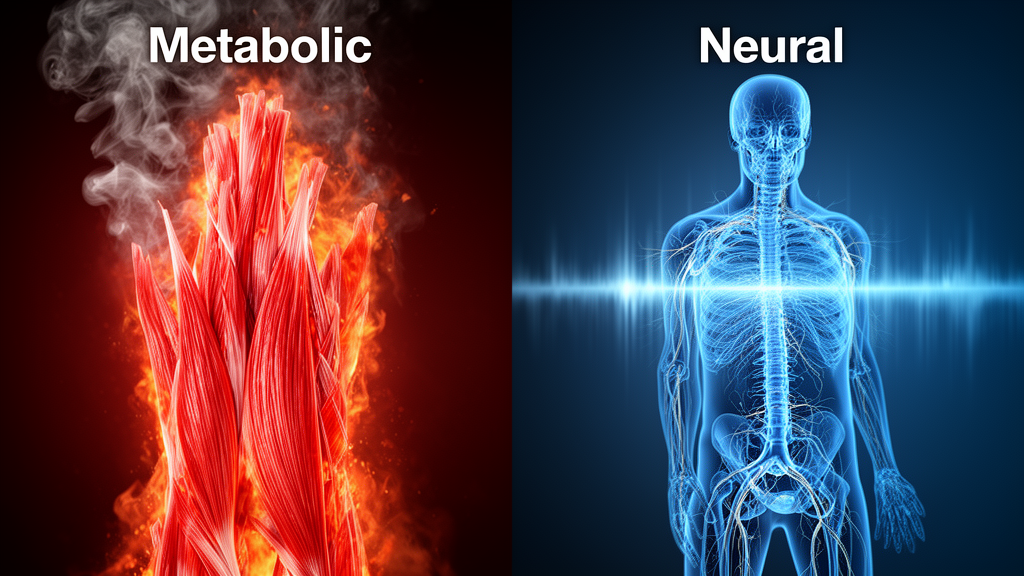
- Metabolic Recovery: Your heart rate and breathing stabilize in 60 to 90 seconds.
- Neural Recovery: Your CNS can take 3 to 5 minutes or longer to return to baseline after a true 1RM effort.
If you rely on your heart rate to tell you when to lift, you are lying to yourself. You might feel “fresh” while your nervous system is still rebooting.
Signs You Are CNS Fatigued
Since you cannot feel neural fatigue like a muscle burn, you must look for external signs.
- Grip Strength Loss: The hands are the first to go. If holding the bar feels harder than usual, your CNS is drained.
- Coordination Breakdown: If your technique feels “wobbly” or precise movements feel clumsy.
- Velocity Drop: The weight moves visibly slower, even if you complete the rep.
- Low Motivation: A sudden feeling of apathy or “I don’t want to do this set.”
Practical Application
For strength training, you must respect the neural clock.
Do not rush.
If you are training for power or maximal strength, take the full 5 minutes. Use this time to visualize the lift. Visualization keeps the neural pathways active without draining the battery.
Our Rest Timer includes a specific “Neural Recovery” visualization. It ignores your heart rate and tracks the scientifically established recovery curve of your central nervous system. It forces you to wait until the signal strength is back to 100%.
Maximize your output. Respect the signal.
If you want to estimate how demanding your working sets really are before choosing a rest interval, use the 1RM calculator and compare the result with the preset breakdown.
If you want to track this across a session rather than guess at it, see tracking CNS recovery between sets.