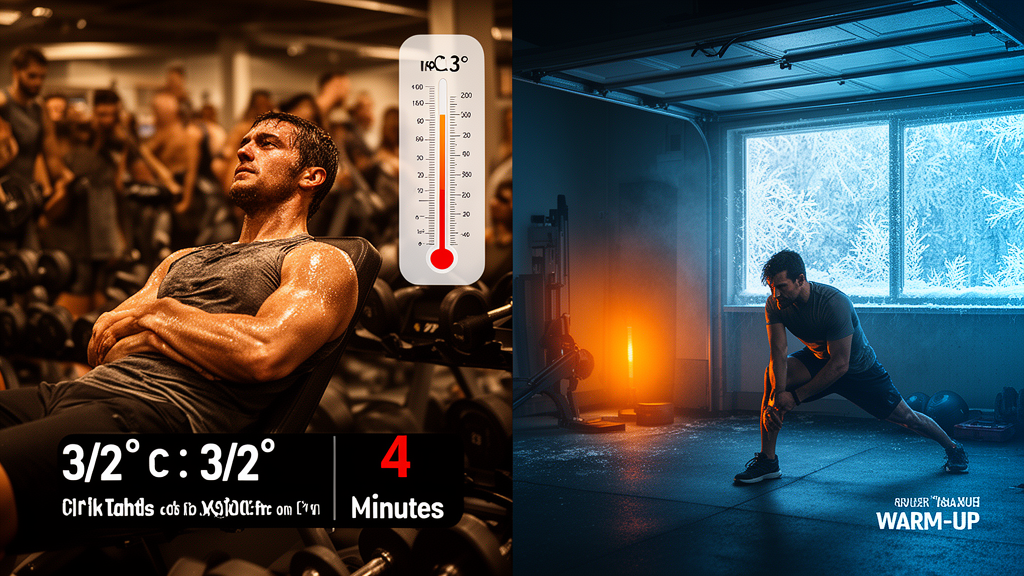
Quick answer: yes. In a hot gym above roughly 25 degrees Celsius, add 30 to 60 seconds to your rest because thermoregulation competes with recovery. In a cold gym, keep rest similar but extend your warm-up and keep moving so you stay ready between sets.
Gym temperature is treated as background noise by most strength athletes — an inconvenience to be ignored rather than a variable to be managed. The physiology disagrees. In environments above 25 degrees Celsius, the cardiovascular cost of thermoregulation adds meaningfully to the demand of each set, and the recovery that happens between sets is correspondingly slower. In very cold environments, a different set of challenges applies to warm-up protocols and post-activation potentiation windows. Both conditions require adjustments to how rest periods are programmed.
Heat and Cardiovascular Drift
The human body maintains core temperature within a narrow range. When ambient temperature rises, the primary cooling mechanism is skin blood flow — the cardiovascular system routes more blood to the skin surface where heat can be dissipated through sweat evaporation. This routing competes directly with the demand for blood flow to working muscles.
During a set of heavy squats at 18 degrees Celsius, cardiac output is directed overwhelmingly toward the working muscles with minimal thermoregulatory demand. The same set at 30 degrees Celsius requires simultaneous high delivery to working muscles and high delivery to the skin for cooling. The heart must work harder to meet both demands, producing a higher heart rate at equivalent work output — typically 10 to 20 beats per minute higher in hot versus neutral conditions at matched intensity.
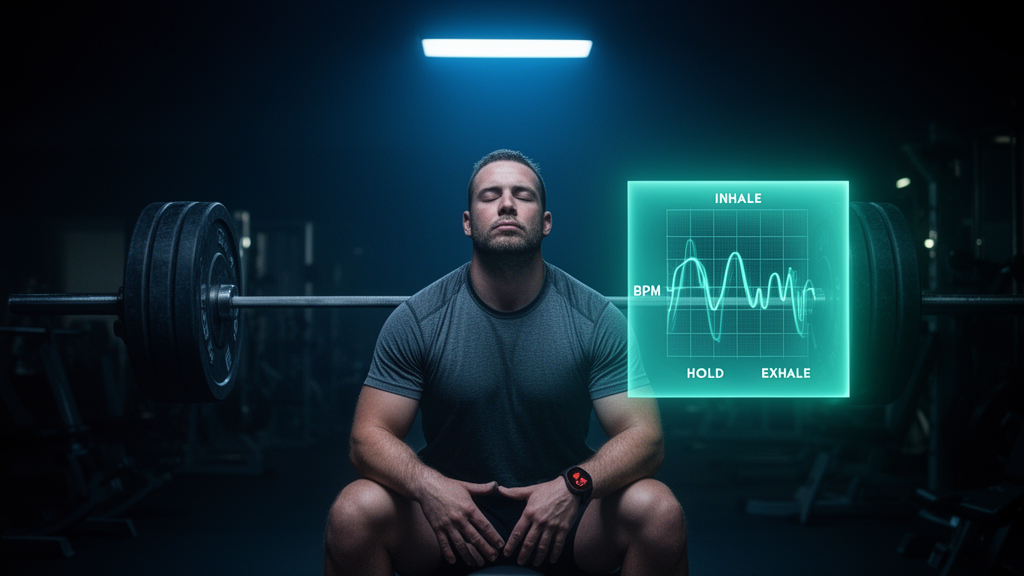
Because heart rate recovery is a primary determinant of between-set recovery readiness, a set that drives heart rate to 170 in the heat — versus 155 in neutral conditions — takes correspondingly longer to recover from. Adding 30 to 60 seconds to each standard rest preset is a reasonable adjustment for hot gym conditions above 25 to 28 degrees Celsius.
Heart rate recovery dynamics and their relationship to set readiness are covered in detail at heart rate recovery between sets.
Why Sessions Feel Harder in Hot Gyms
Beyond objective cardiovascular effects, thermal load increases perceived exertion — the subjective feeling of effort at a given workload. Research in exercise physiology consistently shows that the same absolute workload produces higher ratings of perceived exertion in hot versus temperate conditions. This is not simply discomfort; it reflects genuine physiological competition between thermoregulatory and locomotor demands for systemic resources.
The practical result is that an athlete’s rating of readiness to begin the next set is unreliable in hot conditions. Feeling “ready” after 90 seconds may reflect only that the psychological discomfort of the previous set has faded, not that cardiovascular and metabolic recovery is complete. Using a timer and honoring the extended rest period is more important in hot conditions precisely because subjective recovery cues are less reliable.
The Dehydration Multiplier
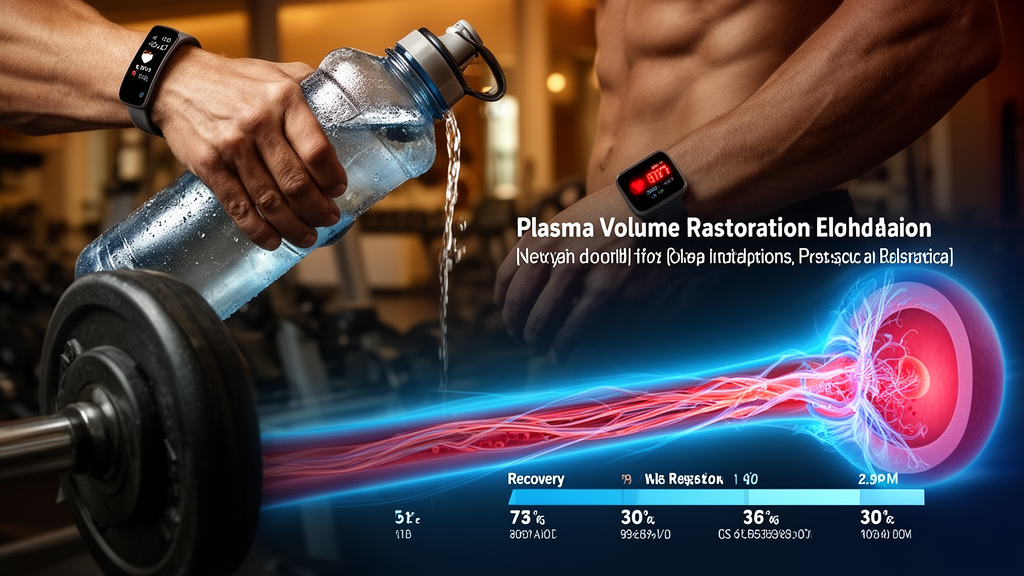
Heat training accelerates sweat rate compared with training in temperate conditions. A session that produces 500 ml of sweat at 20 degrees Celsius may produce 800 to 1,000 ml at 30 degrees Celsius. As session duration increases, cumulative dehydration compounds the cardiovascular drift from heat exposure, creating a multiplicative effect where both thermal load and fluid deficit independently increase heart rate and slow recovery.
This dehydration-heat interaction is the primary reason that athletes training in hot conditions experience dramatically worse session quality after the first 30 to 40 minutes compared with cold or temperate training. The beginning of the session is manageable; the compounding effects accumulate.
Managing the hydration component is covered in detail at hydration and rest period recovery. In hot gym conditions, the fluid replacement recommendations from that article apply with even greater urgency.
The cardiovascular consequences of insufficient recovery in hot conditions — including lightheadedness after heavy efforts — are addressed at dizziness after deadlifts.
Cold Environments: Different Challenges
Cold gym training — below approximately 12 to 15 degrees Celsius — creates a different set of problems. Low muscle temperature reduces the rate of biochemical reactions in the muscle, including the ATP-generating reactions that power contraction. Cold muscles are also less extensible, increasing injury risk during explosive movements. The warm-up requirements are substantially greater in cold environments.
The relationship between muscle temperature and rest periods operates differently in cold conditions. Once adequately warmed up, muscle temperature is maintained partly by the metabolic heat generated during sets. Rest periods that are too long in a cold gym allow muscle temperature to drop back toward ambient, requiring an additional warm-up before the next set can be performed at full intensity. This sets an effective ceiling on rest duration in cold environments — resting beyond 5 to 6 minutes may require re-warming before the next working set.
Post-activation potentiation windows are also shorter in cold conditions. PAP — the temporary performance enhancement following a heavy activation set — depends on elevated muscle temperature and calcium sensitivity. In cold environments, both decay faster after a heavy set than in temperate conditions.
For context on warm-up set rest period management, see warm-up set rest.
Practical Adjustments by Temperature
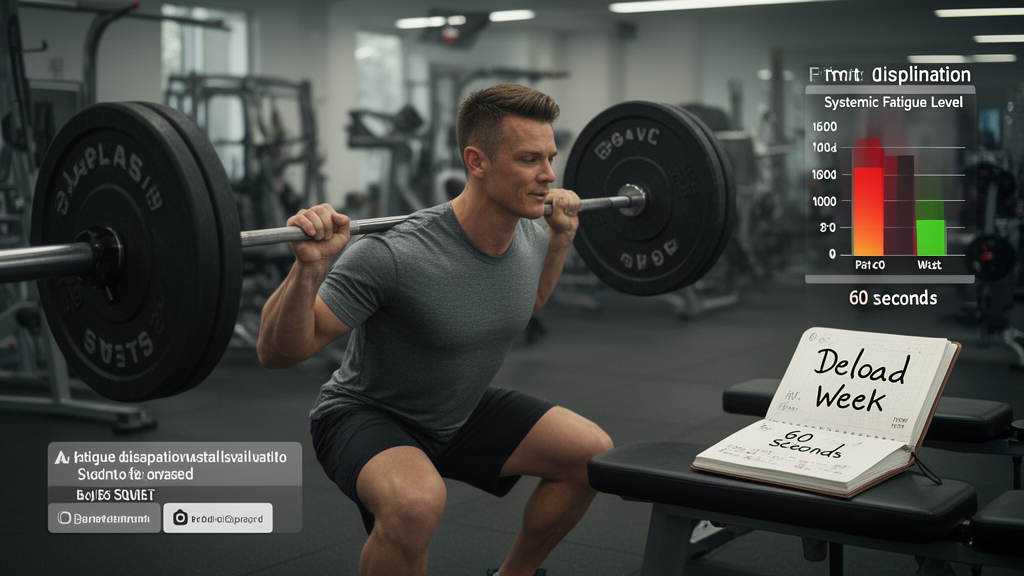
For environments above 25 degrees Celsius: add 30 seconds to each standard rest preset. Increase fluid intake by 200 to 300 ml per hour above baseline recommendations. Monitor readiness subjectively but prioritize the extended timer over perceived readiness.
For environments below 12 to 15 degrees Celsius: extend warm-up to 10 to 15 minutes with progressive loading rather than the standard 5 to 8 minutes. Limit maximum rest to 4 to 5 minutes on working sets to prevent muscle temperature decay. Keep warm clothing accessible during rest periods.
For temperate conditions — 18 to 22 degrees Celsius — standard rest period recommendations apply without adjustment.