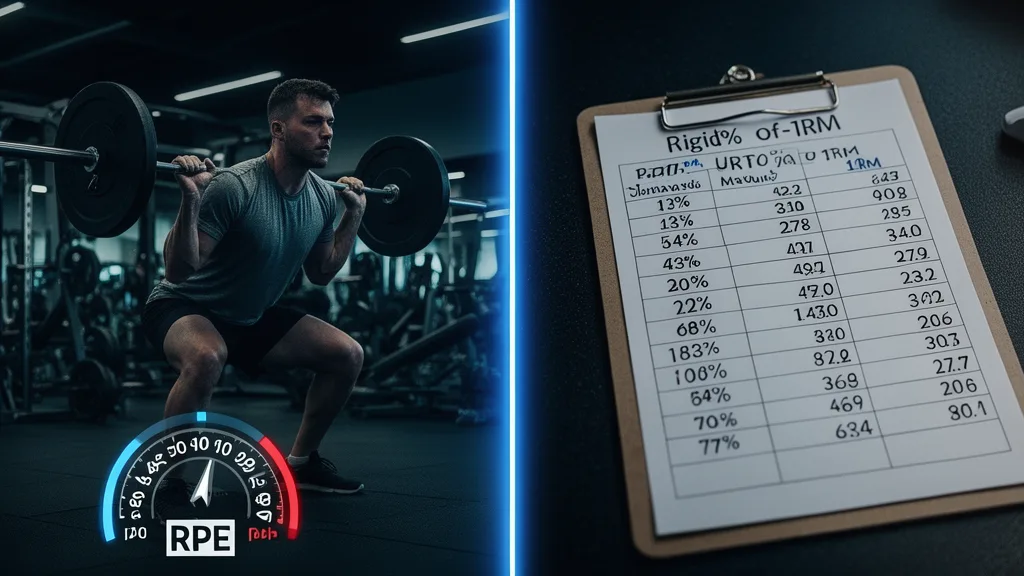
Percentage-based training tells you what to lift before you walk in. RPE-based training tells you how hard to work once you are there. Neither is universally better — they fail in different ways, and the right choice depends on your experience, your goal, and how predictable your life is.
The Core Difference
| Percentage of 1RM | RPE | |
|---|---|---|
| Load decided | In advance, from your max | On the day, from how the set feels |
| Adapts to bad days | No | Yes |
| Adapts to good days | No | Yes |
| Needs an accurate current max | Yes | No |
| Needs lifter experience | No | Yes |
| Best for | Beginners, peaking blocks, precise planning | Experienced lifters, volume work, variable schedules |
Where Percentages Win
You have a reliable, current max. If you tested recently and train consistently, percentages give you a clean progression you do not have to think about mid-session.
You are peaking for a meet or a test. Peaking blocks depend on planned loads landing on planned dates. Autoregulating a peak tends to let lifters take more than the plan intended, which is exactly the wrong error that close to a competition.
You are new. This is the strongest case for percentages. Rating proximity to failure requires having been near failure enough times to recognize it, and newer lifters routinely call a set RPE 9 with three reps still in the tank. A percentage does not care whether your judgment has developed yet.
You want the decision made for you. Some lifters simply train better when the number is not negotiable at 6am.
Where RPE Wins
Your readiness varies. Sleep, stress, food, and life load all move what you can do on a given day by more than most people expect. A fixed 85% is too light on a great day and too heavy on a bad one. RPE absorbs that automatically.
Your max is out of date or unknown. After a layoff, an illness, or a long hypertrophy block, your old max is a guess. RPE works without one.
You are doing volume work. For hypertrophy sets in the 6 to 12 range, precisely which percentage you use matters far less than working at a consistent, appropriate distance from failure. RPE targets that directly.
You want to avoid grinding. Percentages will happily send you into a set you have no business taking on a bad day. An RPE cap stops that before it costs you a session.
The trade-off is real, though. RPE requires honest self-assessment, and honesty is harder when you are motivated. Lifters who chronically under-rate their sets end up training closer to failure than intended and accumulating more fatigue than planned.
The Practical Answer: Use Both
Most well-built programs combine them, and the combination is more useful than either alone.
Percentage with an RPE cap. A prescription of 4x5 at 80% with a cap of RPE 8 means work at 80%, but if that turns out to be harder than an RPE 8 today, reduce it. The plan sets direction, the RPE protects you from a bad day.
Percentage for main lifts, RPE for accessories. Keep your squat and bench progression objective, and run rows, curls, and extensions at RPE 8 to 9 where precision is not the point.
RPE to select, percentage to verify. Choose the day’s load by feel, then check afterward what percentage it represented. Over a few weeks that tells you whether your RPE judgment is calibrated.
How Rest Fits Into Both
Whichever system you use, rest is what makes the prescription achievable. A set at 85% or RPE 9 needs 3 to 5 minutes to repeat at quality; cut that to a minute and you will miss the prescribed reps regardless of which notation the program used. The RPE calculator converts between effort and load, and the rest recommender will suggest a rest range matched to the goal, lift, and how hard the set actually was.
The Bottom Line
Use percentages when your max is current and the plan must land on schedule, especially as a beginner or when peaking. Use RPE when your readiness varies, your max is uncertain, or you are accumulating volume. Then stop treating it as a choice: put a percentage on the page and an RPE cap beside it, and you get objective progression with a daily safety valve.
For decoding how these appear in a written program, see how to read a workout program.