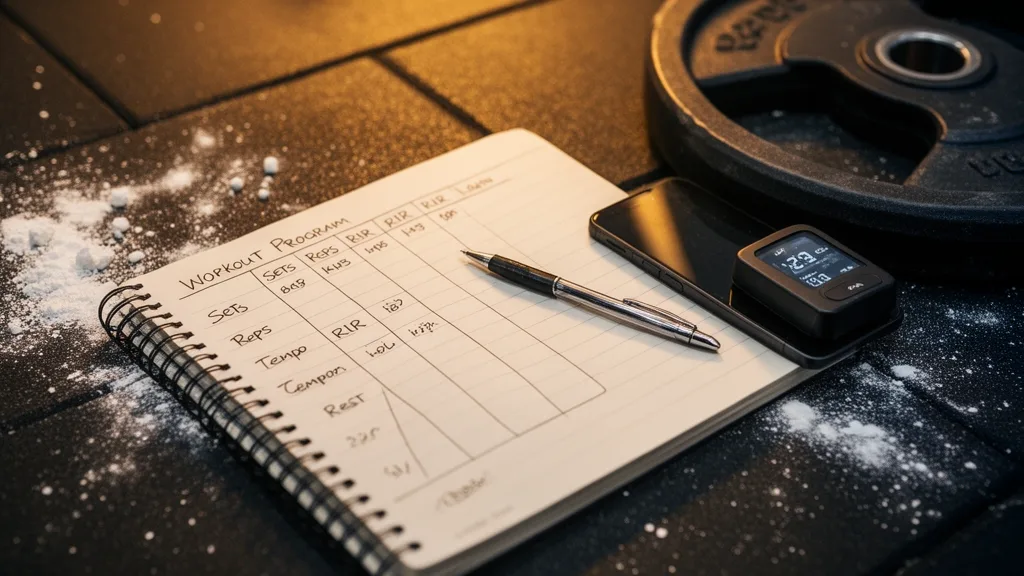
A program written as Back Squat — 4x8 @ RPE 8, 3010, 120s contains five separate instructions, and each one changes the session. Here is what every part means and how to actually run it.
The Anatomy of One Program Line
| What you see | What it means |
|---|---|
4x8 |
4 sets of 8 reps. Sets always come first |
@ RPE 8 |
Take each set to a difficulty of 8 out of 10, about 2 reps short of failure |
2 RIR |
Same instruction in the other notation: stop with 2 reps in reserve |
@ 75% |
Use 75% of your one-rep max for the load |
3010 |
Tempo: 3s down, 0s pause, 1s up, 0s pause at the top |
120s or 2' |
Rest 120 seconds between sets |
AMRAP |
As many reps as possible on that set |
E2MOM |
Every 2 minutes on the minute |
Sets and Reps
The first number is sets, the second is reps. 5x5 is five sets of five. When you see a range like 3x8-12, the range is the target window: aim for the top of it, and add load next session once you hit the top number on every set.
Rep ranges are shorthand for the training goal. Roughly, 1 to 5 reps biases strength, 6 to 12 biases hypertrophy, and 15-plus biases endurance. That mapping is also what determines the rest instruction, as covered in how long to rest between sets.
Intensity: Percentage, RPE, or RIR
Programs prescribe effort in one of three ways.
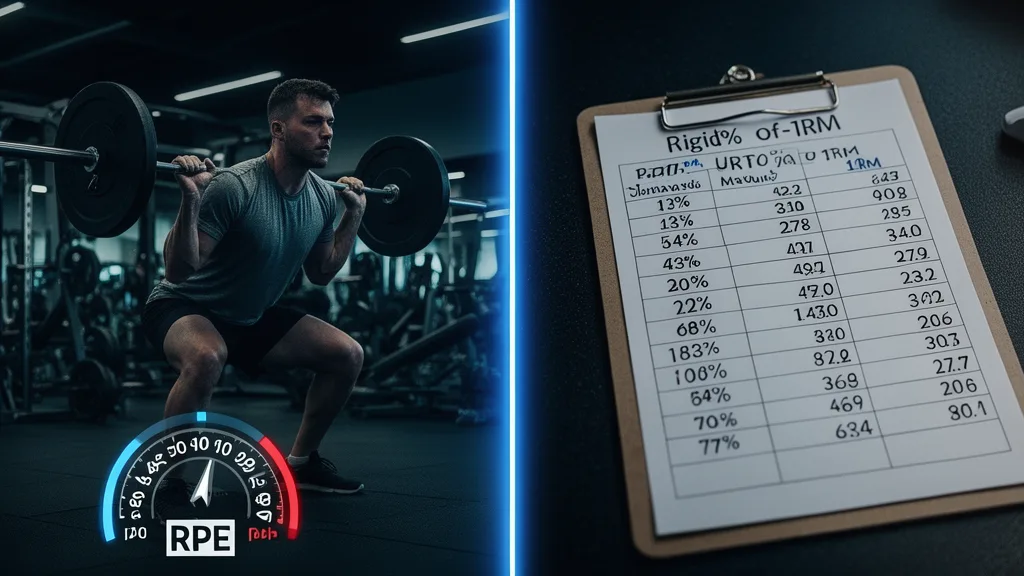
Percentage of 1RM is objective and fixed: 75% of a 200 lb max is 150 lb, regardless of how you feel that day. It is precise but blind to fatigue, sleep, and stress.
RPE rates the set from 6 to 10 based on how close to failure you took it. RPE 8 means roughly two reps left.
RIR counts the same thing directly. 2 RIR is two reps left, which is RPE 8. The two systems are interchangeable: RPE = 10 − RIR.
If a program gives you RPE or RIR and you are unsure how that maps to weight, the RPE calculator converts between effort, load, and estimated max. The trade-offs between the two approaches are covered in RPE vs percentage training.
Tempo
Tempo is four digits, always in this order:
- Eccentric, lowering the weight
- Pause at the bottom
- Concentric, lifting the weight
- Pause at the top
So 3010 is a 3-second lower, no pause, a 1-second lift, no pause. 31X0 means 3 seconds down, 1 second paused, then explode up as fast as possible. Tempo is prescribed to increase time under tension, enforce control, or drill a position, and ignoring it changes the exercise.
Rest, the Most Ignored Instruction
Rest is written as seconds, minutes, or a range: 90s, 2', 3-5 min. It is the instruction lifters most often skip, and skipping it undoes the rest of the line.
If a program says 3 minutes and you take 1, your energy systems are only partly recovered when the next set starts, so you will miss the prescribed reps at the prescribed load. The session stops being the session that was written. The recovery numbers behind this are in how long ATP takes to recover, and the rest recommender will suggest a range when a program leaves rest unspecified.
Worked Example
Bench Press — 4x6 @ RPE 8, 2010, 180s
Perform four sets of six reps. Pick a load where the sixth rep leaves you about two reps short of failure. Lower the bar over two seconds, no pause on the chest, press up over one second, no pause at the top. Rest three full minutes between each set. If set three drops to four reps, the load was too heavy or your rest was too short.
The Bottom Line
Read every program line as five instructions rather than one: how many sets, how many reps, how hard, how fast, and how long you rest. Follow all five and you are running the program. Follow two of them and you are improvising with someone else’s exercise selection.
Which lift to put first, and why it matters, is covered in exercise order.
For a worked example of a percentage-based template, see 5/3/1 rest periods.