Quick answer: it depends entirely on what you are training, and the range is wider than most people expect.
| What you are doing | Example | Rest |
|---|---|---|
| Conditioning volume | High-rep push-ups, squats | 45 to 90 seconds |
| Strength work | Weighted pull-ups, dips | 2 to 3 minutes |
| Skill and near-maximal | Muscle-ups, front lever, planche | 3 to 5 minutes |
Bodyweight training is not automatically low-recovery. High-skill movements need the most rest of any category, because a fatigued attempt teaches your body the wrong pattern. The reasons follow.
Calisthenics is often treated as a lower-stakes training discipline — the assumption being that because you are moving your own body weight rather than external load, recovery demands are similarly modest. This assumption leads to chronic under-resting, particularly on high-skill movements where the consequences are both performance degradation and reinforced poor mechanics.
Rest periods in calisthenics span a wider range than most other training modalities, from 60 seconds for conditioning volume to 5 full minutes for maximal skill attempts. Understanding what drives that range is essential for structuring effective sessions.
Why Skill-Based Movements Demand More Rest Than Equivalent Barbell Work
A barbell squat at a given percentage of one-rep max is primarily a strength and metabolic challenge. The movement pattern is relatively simple and well-grooved by the time an athlete is training near maximal loads. The limiting factor is phosphocreatine availability and neuromuscular force output.
A muscle-up or a handstand attempt carries all of those demands plus a substantial motor-control layer. The cerebellum and motor cortex must coordinate timing, joint angles, and force application across multiple segments simultaneously. This neural complexity means that fatigue affects not only raw force but also the precision required to execute the pattern correctly.
Neural fatigue — depletion of the neurotransmitter and calcium-handling systems that enable precise motor output — is the primary driver of rest requirements for skill-based calisthenics. A fatigued attempt at a muscle-up does not just produce a failed rep; it can reinforce faulty compensation patterns that then require deliberate effort to undo. For a deeper understanding of this fatigue type, see CNS fatigue explained and the comparison of neural versus metabolic fatigue.
Rest Recommendations by Movement Category
The following categories reflect both the metabolic demand and the skill complexity of common calisthenics movements.
Conditioning volume — 60 to 90 seconds
High-repetition push-ups, bodyweight squats, jumping jacks, and similar movements in the 15 to 30 repetition range are primarily glycolytic and aerobic challenges. The movements are well-learned and do not require high motor precision at submaximal effort levels. Sixty to ninety seconds provides partial lactate clearance and sufficient cardiovascular recovery to maintain quality across sets. Shorter rest is appropriate if conditioning adaptation is the explicit goal.
Strength work — 2 to 3 minutes
Weighted pull-ups, ring dips, parallel bar dips with added load, L-sit holds, and similar loaded or near-maximal bodyweight expressions require substantially more rest. The phosphagen system is the primary energy source, and phosphocreatine recovery to the 85 to 95 percent range takes 90 seconds to 3 minutes. Two to three minutes is the appropriate range for athletes whose goal is strength development on these movements.
Skill work — 3 to 5 minutes
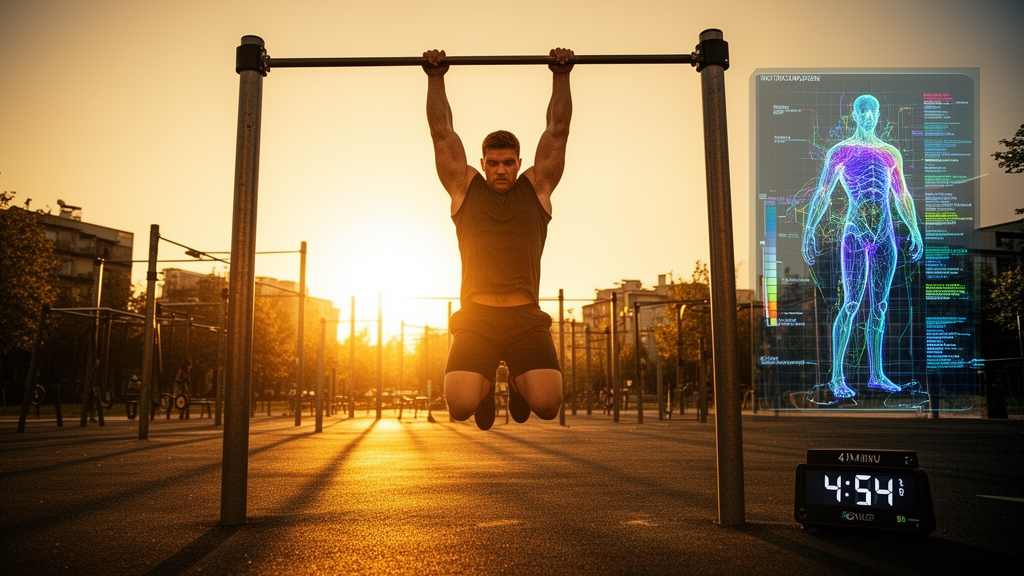
Muscle-ups, handstands, front lever attempts, back lever progressions, planche progressions, and similar high-skill movements require the longest rest intervals of any calisthenics category. The combination of near-maximal neural output and high motor precision means that incomplete recovery produces both worse performance and worse movement quality. Three minutes is a minimum; five minutes is appropriate for true maximal attempts.
| Movement Type | Examples | Rest Range |
|---|---|---|
| Conditioning volume | Push-ups, bodyweight squats | 60-90 seconds |
| Strength work | Weighted pull-ups, ring dips | 2-3 minutes |
| Skill-strength | Bar muscle-ups, L-sit to press | 3-4 minutes |
| Maximal skill attempts | Handstand, front lever, planche | 4-5 minutes |
The Skill-Fatigue Connection
The most important principle specific to calisthenics is that fatigue corrupts skill acquisition. When you attempt a muscle-up in a fatigued state, the motor cortex does not simply produce a weaker version of the correct movement — it produces a different movement entirely, one characterized by compensation and timing errors.
If these fatigued-state movement patterns are repeated frequently enough, they can become embedded as default motor programs. This is the neurological basis of the training principle that skill work should never be practiced to failure. Rest enough to execute the movement correctly on every attempt, and stop before compensation begins.
For athletes using this principle with weighted pull-up training, the weighted pull-up rest guide provides additional specifics. Use the rest timer presets to set appropriate intervals before your session begins.
Comparing lifts? The rest by exercise lookup shows the rest range for every major movement side by side.