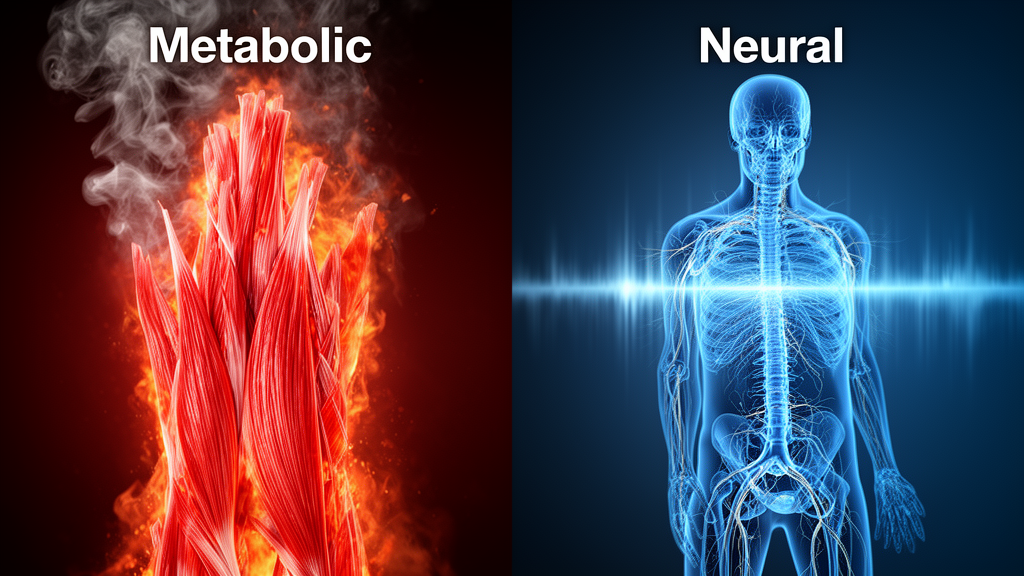
Quick answer: metabolic fatigue is local burning and pump from accumulated metabolites, and it clears in a few minutes. Neural fatigue is your nervous system’s reduced ability to recruit high-force motor units, and it takes longer to recover. Heavy low-rep work causes mostly the second; high-rep work causes mostly the first.
You are about to fail a rep. But why are you failing?
The answer dictates everything about your training. It determines how long you should rest, how often you can train, and what results you will get.
There are two primary types of fatigue in the gym: Metabolic Fatigue and Neural Fatigue.
They feel different. They act different. And they require different solutions.
The Tale of Two Failures
1. Metabolic Fatigue known as the burn
This is what bodybuilders chase.
- The Feeling: Intense burning sensation, pump, tightness, “jelly legs.”
- The Cause: Accumulation of metabolites like lactate, hydrogen ions, and inorganic phosphate.
- The Mechanism: The acidity in the muscle interferes with calcium release, preventing the fibers from contracting.
- Recovery Time: Fast, which is 24 to 48 hours.
- Best For: Muscle Growth also known as Hypertrophy.
2. Neural Fatigue known as the drain
This is what powerlifters manage.
- The Feeling: Shaking, loss of coordination, feeling “heavy” or “slow,” grip weakness. No burn.
- The Cause: Depletion of neurotransmitters and reduced excitability of motor neurons.
- The Mechanism: The brain sends a signal, but the transmission line is “noisy” or weak. The muscle never gets the full message to contract.
- Recovery Time: Slow, such as 48 to 96 hours or more.
- Best For: Maximal Strength.
The Mechanism: Why Calcium Ions Matter
To understand the neural fatigue vs metabolic fatigue difference, we have to look at the microscopic level of muscle contraction.
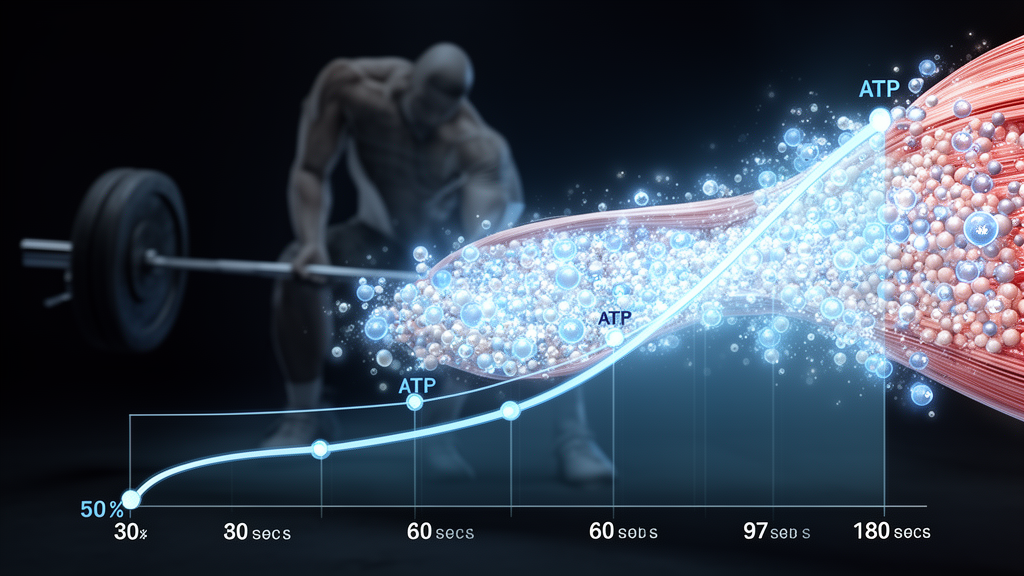
One of the most overlooked aspects of metabolic fatigue is calcium ion uptake muscle fatigue. For a muscle to contract, your nervous system releases calcium ions into the muscle cell. These ions bind to proteins that allow muscle fibers to slide together.
In an acidic environment, which results in low pH from H+ accumulation, the “cleanup” crew that pumps calcium back out of the cell slows down. This prevents the muscle from resetting for the next contraction. You might have the neural drive, but the chemical environment in the muscle is literally locked in a state of paralysis.
Fast Twitch vs Slow Twitch Recovery
Your muscle fiber type also dictates your fast twitch muscle fiber recovery time.
- Type II also known as Fast Twitch: These are your “power” fibers. They are highly explosive but prone to both neural and metabolic exhaustion. They take significantly longer to recover—often requiring the full 3-5 minute rest window.
- Type I also known as Slow Twitch: These are your “endurance” fibers. They have a massive “drain” for metabolic waste and recover almost instantly neurally. This is why you can walk for hours without seeing a drop in force, but can only sprint for seconds.
Diagnosis: Which One Is It?
Imagine you are doing a set of 12 reps on leg extensions.
- Reps 1-8: Easy.
- Reps 9-11: Your quads start screaming. The pain is unbearable.
- Rep 12: You physically cannot lift the leg despite trying hard.
- Diagnosis: Metabolic Fatigue. Your engine is flooded.
Now imagine you are doing a 1-rep max deadlift.
- The Setup: You feel hyped. No pain.
- The Pull: The bar breaks the floor. It moves up two inches. Then it just stops.
- The Result: You pull with everything you have, but it feels like the plug was pulled. No burn. Just a power outage.
- Diagnosis: Neural Fatigue. Your battery died.
Rest Period Implications
This distinction is why “one size fits all” rest periods fail.
If you are training for Metabolic Fatigue such as Hypertrophy:
If you are training for Neural Adaptation such as Strength:
- You want zero fatigue. You need a pristine signal.
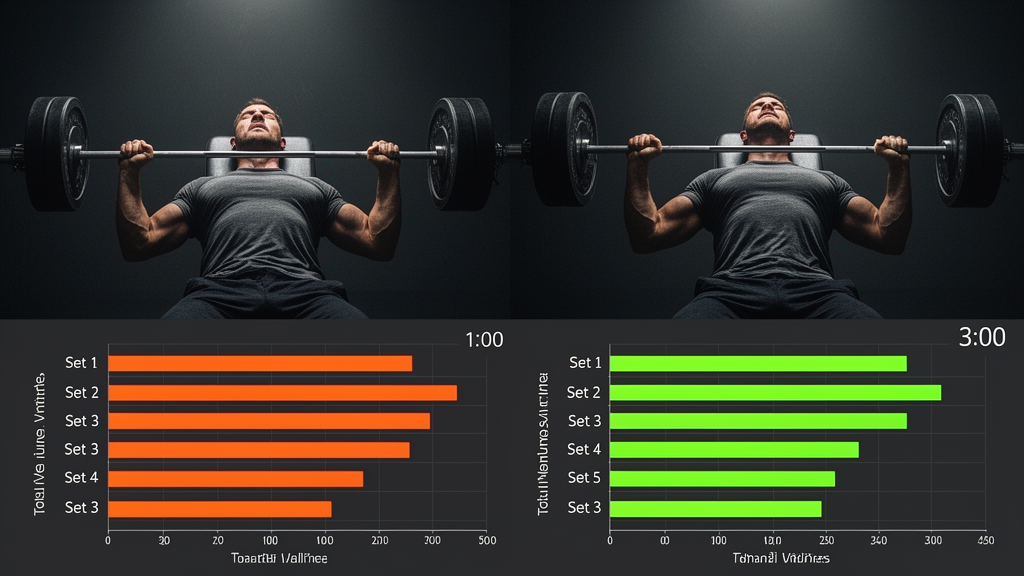
- Rest: 3 to 5 minutes.
- Goal: Complete recovery to maximize force output and ensure fast twitch muscle fiber recovery.
Programming Your Week
You can train metabolically in a bodybuilding style fairly often because the system recovers quickly. This is why bodybuilders can train 5-6 days a week.
You cannot train neurally with maximal lifting every day. If you try to max out your deadlift Monday, Wednesday, and Friday, you will fry your CNS. Your strength will regress. You will get injured.
The Hybrid Athlete
Most of us want both size and strength. The key is to sequence your workout.
- Start Neurally: Do your heavy compound lifts first, such as Squat, Bench, and Deadlift, with long rest. Fresh CNS.
- Finish Metabolically: Move to accessory work, such as Leg Press and Dumbbells, with short rest. Chase the pump.
Our Rest Timer is designed for this hybrid approach. You can toggle between “Strength” and “Hypertrophy” modes mid-workout, adjusting your recovery visualization to match the system you are taxing.
Know your fatigue. Choose your rest.
At the cellular level, a large part of this comes down to calcium ion handling in muscle fatigue.