Quick answer: across the research, 3 minutes beats 1 minute for strength by a clear margin, and produces at least as much muscle growth because it lets you complete more total volume. The gap is largest on heavy compound lifts and smallest on isolation work.
The Research Verdict
Three minutes beats one minute. For both muscle growth and strength development, 3-minute rest periods produce significantly better outcomes than 1-minute rest periods in controlled research. This finding holds across trained subjects performing standard resistance training protocols.
The fitness industry spent decades promoting short rest as superior for hypertrophy — arguing that the metabolic stress and elevated anabolic hormone response from incomplete recovery drove more growth. The controlled data does not support that conclusion.
The Schoenfeld 2016 Study
The most-cited controlled trial on this question was published by Brad Schoenfeld and colleagues in the Journal of Strength and Conditioning Research in 2016. Twenty-one resistance-trained men completed an 8-week full-body strength program. Subjects were matched for training experience and randomly assigned to either 1-minute or 3-minute inter-set rest conditions. All other variables — exercises, sets, reps, load, and frequency — were held constant.
The results were unambiguous. The 3-minute rest group demonstrated significantly greater increases in upper body and lower body strength compared to the 1-minute group. For muscle thickness measured via ultrasound, the 3-minute group also showed greater hypertrophy in both biceps brachii and quadriceps — the two muscles assessed.
The 1-minute group did not stagnate. Both groups improved. But the 3-minute group improved more on every primary outcome over the same 8-week period.
The Physiological Mechanism
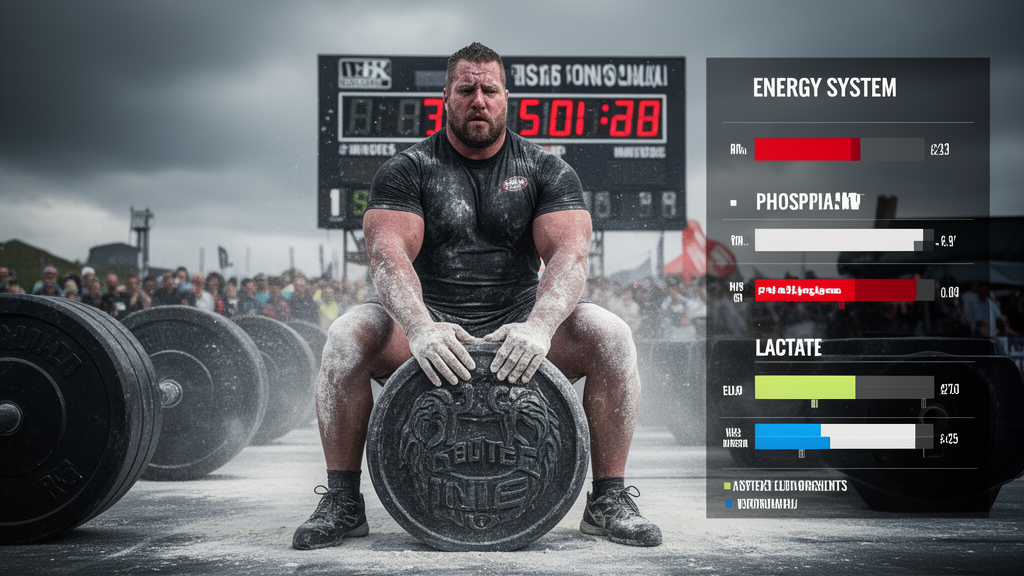
The result follows directly from ATP-PC recovery kinetics. After a working set that takes the ATP-PC system close to depletion, phosphocreatine resynthesis follows a predictable exponential curve:
- At 1 minute: approximately 50 to 70% of phosphocreatine restored
- At 2 minutes: approximately 90 to 95% restored
- At 3 minutes: approximately 97 to 99% restored
When you begin the next set at 50% phosphocreatine, you are attempting to produce near-maximal force with critically compromised energy availability. The set will either be completed at reduced quality — fewer reps, faster breakdown in form — or it will be cut short when fatigue becomes the limiting factor rather than genuine muscular stimulus.
Over 3 sets, 5 sets, 10 exercises, and 52 weeks, that compromise compounds. The 3-minute group was not just recovering more between sets in a single session — they were accumulating higher-quality training volume week after week.
Volume Math: What Short Rest Costs You
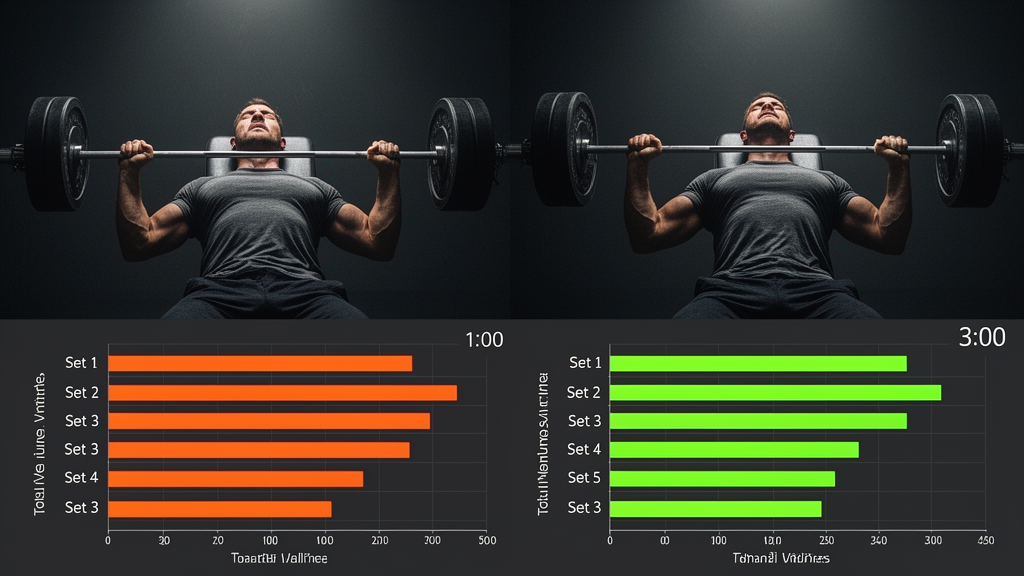
Consider a compound pressing movement performed at 80% of one-rep max — a standard hypertrophy load. With a 1-minute rest, rep performance typically looks like this across three working sets:
With 1-minute rest:
- Set 1: 10 reps
- Set 2: 7 reps — partial phosphocreatine, accumulated fatigue
- Set 3: 5 reps — significant depletion, form degrading
- Total reps: 22
With 3-minute rest:
- Set 1: 10 reps
- Set 2: 10 reps — near-complete phosphocreatine restoration
- Set 3: 9 reps — minor cumulative fatigue
- Total reps: 29
That is a 32% volume difference from a single exercise. Across a full session of 6 to 8 exercises, the cumulative volume gap between a 1-minute and 3-minute rest protocol is substantial. Volume is the primary driver of hypertrophy stimulus over time.
For a more detailed breakdown of why this volume effect compounds into greater muscle growth, see the dedicated article on resting 3 minutes for hypertrophy.
When 1-Minute Rest Is Appropriate
Short rest periods are not inherently wrong — they are wrong when applied to the wrong context.
One-minute rest is appropriate for conditioning finishers at the end of a session. Circuit training, metabolic conditioning blocks, and high-rep isolation work where the goal is cardiovascular challenge or muscular endurance — not peak force production — all pair well with short rest.
Isolation supersets are another valid context. When pairing two antagonist isolation movements — biceps curl followed by triceps pushdown, for example — the working muscles are distinct enough that 1-minute rest between supersets allows adequate local recovery.
Aerobic capacity work using resistance training formats — complexes, density blocks, and similar — is also designed around incomplete rest. The fatigue itself is the stimulus in these protocols. See the companion article on 1-minute rest for strength for a complete breakdown of where short rest delivers results.
The Practical Application
For any compound strength exercise — squat, deadlift, bench press, overhead press, row — use the 3-minute preset. This is not a conservative choice. It is the scientifically supported choice for maximizing both strength and hypertrophy outcomes.
For isolation work in a hypertrophy program, 90 seconds is sufficient and keeps session length manageable. Save the full 3 minutes for the exercises where phosphocreatine depletion is the limiting factor.
Start a session on the timer using the 3-minute preset for your main lifts and 90 seconds for accessories. The difference in set quality will be apparent within the first session.
The ATP-PC recovery calculator shows the difference between those two rest lengths as a recovery percentage.