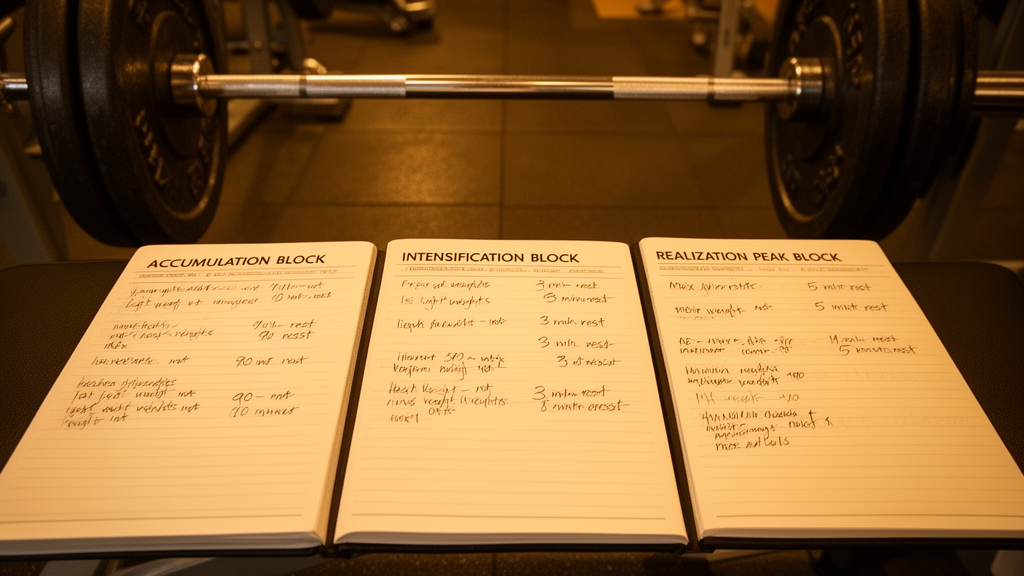
Quick answer: rest changes by block. Accumulation blocks with higher volume and moderate load use 90 seconds to 2 minutes; intensification and peaking blocks with heavy near-maximal work use 3 to 5 minutes. Match rest to the block’s purpose rather than keeping one number all year.
Most lifters change their sets, reps, and intensity as they move through training phases. Far fewer change their rest periods to match. This is a missed optimization. Rest periods are a programming variable just like volume and intensity, and they should be deliberately adjusted as the training block shifts its target adaptation.
Block Periodization Overview
Block periodization organizes training into sequential phases — commonly called accumulation, intensification, and realization — each with a defined primary adaptation target. The logic is that concentrating training stress on one quality at a time produces better long-term results than always training everything simultaneously. Vladimir Issurin, who formalized this model, described blocks as having specific “residual effects” — the period over which adaptations persist after a block ends — and the sequencing of blocks takes those residuals into account.
The rest period that optimizes each block’s primary adaptation differs in ways that are physiologically significant, not merely cosmetic.
Accumulation Block: High Volume, 90 to 120 Seconds
The accumulation block prioritizes training volume — more sets, more total reps, often at 60 to 75% of one-rep max. The metabolic environment created by moderate rest is an intentional feature of this phase. Short-to-moderate rest intervals maintain elevated lactate levels, increase metabolic stress, and create the hormonal environment associated with hypertrophic signaling.
Rest of 90 to 120 seconds between sets accomplishes several accumulation goals simultaneously. It keeps cardiovascular demand elevated, prevents full phosphocreatine recovery — which maintains glycolytic contribution and metabolic stress — and allows enough recovery to complete the prescribed volume without severe performance degradation. Sessions in this block are often longer than intensification sessions because the rest is shorter but the set count is higher.
The connection between rest period length and hypertrophic adaptation is analyzed in depth at rest periods for strength vs hypertrophy.
Intensification Block: Strength Focus, 2 to 4 Minutes
As the block shifts to intensification, intensities climb to 80 to 90% and rep ranges drop. The training objective shifts from metabolic stress and volume to neural adaptation and contractile strength. This phase requires near-complete phosphocreatine recovery between sets to allow maximum force production on each effort.
Rest of 2 to 4 minutes serves the intensification block’s demands. At 2 minutes, phosphocreatine recovery reaches approximately 92 to 95% — adequate for most 3 to 5 rep sets. At 4 minutes, recovery is essentially complete at 97 to 99%, supporting true maximal strength expression. The right rest within this range depends on the specific intensity of each working set.
Cutting rest during an intensification block is one of the most common programming errors at this phase. An athlete who enters the block with accumulation rest habits and rests only 90 seconds before a 90% effort will demonstrate apparent strength stagnation that is actually a rest management failure rather than a true strength plateau.
The rest-pause technique, which can be applied within the intensification framework for advanced practitioners, is covered at rest-pause training guide.
Realization Block: Peaking, 3 to 5-Plus Minutes
The realization or peaking block brings intensities to 90 to 100% in preparation for competition or testing. Sets are short — often singles, doubles, or triples — and the quality of each rep is paramount. There is no purpose to accumulating fatigue within a peaking session; the goal is to demonstrate and reinforce maximum performance.
Rest of 3 to 5 minutes or more is the standard for realization block work. Some programs specify rest by feel rather than by clock during this phase, trusting that experienced athletes will self-regulate to the 5 to 8 minutes naturally required before a true maximum attempt. The critical point is that nothing productive happens by resting less — the phosphocreatine curve is essentially flat beyond 3 minutes, so extending to 6 or 8 minutes costs nothing except time.
Heavy squatting at high intensity has specific rest period requirements that align with realization block demands — see heavy squats 5x5 rest period for load-specific guidance.
Why Rest Transitions Matter for Adaptations
Each block is optimizing a different physiological system. The accumulation block targets muscular hypertrophy and cellular metabolic adaptations. The intensification block targets myofibrillar density and neuromuscular efficiency. The realization block consolidates neural adaptations and peaks the expression of accumulated strength.
Mismatching rest to block objectives degrades the specific adaptation that block is designed to produce. Using realization-length rest during accumulation reduces the metabolic stimulus and hypertrophic signal. Using accumulation-length rest during intensification prevents full phosphocreatine recovery and limits the quality of each strength-building effort. The rest period is not incidental to the block — it is part of the stimulus itself.
Practical Block-by-Block Preset Guide
For accumulation blocks, use the 60-second or 90-second preset on the rest timer presets page. For intensification, the 2-minute and 3-minute presets match the rest requirements. For realization work, the 3-minute preset is the minimum, and extending to 5 minutes manually is appropriate for near-maximal and maximal attempts.