Quick answer: strongman events need 3 to 5 minutes between heavy efforts, and often longer, because the long time under tension, heavy grip demand, and cardiovascular cost stack on top of the usual neural fatigue. Recovery here is frequently limited by breathing rather than the muscle.
Strongman is unique among strength sports in the metabolic diversity it demands. A competition day can include a maximal log press single, a 60-second max-rep medley, a 30-meter farmer carry, an atlas stone series, and a heavy yoke walk. Each of these events taxes a different energy system and produces a different recovery curve. Rest period programming must account for this variation rather than applying a single interval across the board.
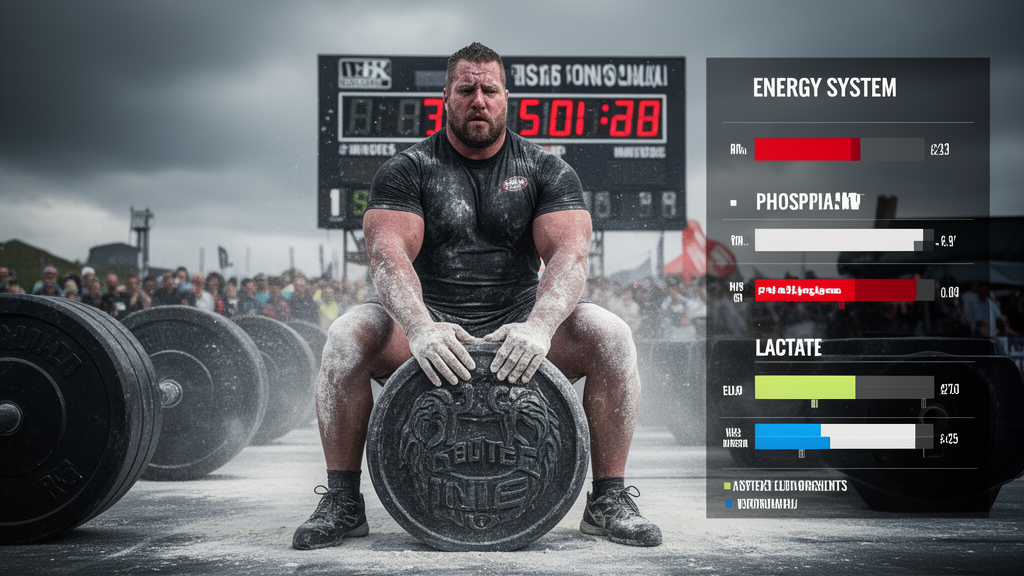
Energy System Profile of Strongman Events
Understanding which energy system dominates each event is the foundation of intelligent rest programming.
The log press and axle press are primarily phosphagen-system movements. A maximal single or a low-rep set at heavy weight takes 3 to 10 seconds and relies almost exclusively on stored ATP and phosphocreatine. The recovery curve mirrors that of any other maximal strength effort: 50% in 30 seconds, 85% in 60 seconds, and 97 to 99% in 3 minutes.
The farmer carry, yoke walk, and sled drag occupy different metabolic territory. These events last 20 to 60 seconds and involve sustained cardiovascular effort alongside significant upper and lower body muscular demand. Lactate accumulates substantially during these efforts, and the cardiovascular system requires additional time beyond phosphocreatine resynthesis to restore cardiac output and clear blood lactate. Full recovery from a maximal carry effort takes 5 to 8 minutes for most athletes.
The atlas stones fall in between. Each stone placement is a near-maximal explosive effort lasting 1 to 3 seconds, but the cumulative demand of a 5-stone series taxes both the phosphagen and glycolytic systems. The lower back and hip extensors receive particular loading, and these muscle groups have slower recovery profiles than the primary movers in press events.
Lactate clearance during active recovery between heavy glycolytic events is covered in the article on lactate clearance and active recovery.
Rest by Event Category
Max-effort log press and axle press. For sets at 85% of one-rep max or above, rest 3 to 5 minutes. For competition-prep singles at 90 to 100%, rest 5 to 7 minutes. The CNS demand of overhead pressing with an implement — which requires rotational stabilization that a barbell does not — adds neural load that extends the minimum rest threshold slightly beyond comparable barbell work.
Atlas stones. Rest 4 to 6 minutes between stone series in training. If working individual stone placements as a technique drill, 2 to 3 minutes between attempts is acceptable. The lower back recovery demand is the limiting factor; repeated short-rest stone work is a common source of lumbar injury in early-stage strongman athletes.
Farmer carry and yoke walk. Rest 5 to 8 minutes between maximal-effort distances. Heart rate recovery and lactate clearance both need to approach baseline before the next attempt to ensure grip, leg drive, and postural integrity are restored. Passive rest is generally preferable to active rest for farmer carry recovery because the forearms and hands need full perfusion restoration.
Tire flip. For max-weight single flips, rest 3 to 4 minutes per attempt. For timed flip series, rest time between series equals at minimum the duration of the series itself — and double the duration is better for quality maintenance.
Deadlift for reps and loading medley. These events combine near-maximal strength with a semi-aerobic element. Rest 5 to 7 minutes between training sets that closely simulate competition effort. For detailed deadlift rest period science, see deadlift rest periods science.
Competition-Day Rest Management
At a competition, athletes do not control inter-event rest — the competition schedule determines it. Standard events at regional and national competitions are separated by 15 to 30 minutes of event transition time. This is ample recovery for most athletes, and the primary rest management challenge shifts from between-set timing to within-event recovery.
The most important competition rest variable is the rest between warm-up attempts and the competition attempt. Strongman athletes often rush warm-ups due to equipment logistics and then step onto the competition floor under-recovered or over-recovered depending on how long the warm-up queue ran. Establishing a warm-up protocol with predictable timing — 4 to 5 minutes between the final warm-up and the competition attempt — is standard practice among elite competitors.
Training Rest to Match Competition Conditions
A training error specific to strongman is completing event training with rest periods much longer than competition separations. An athlete who rests 15 minutes between log press and stones in training will not be prepared for the 8-minute transition that occurs at a competition. Dedicated event-day simulations — where full events are run at competition timing — should be incorporated several times in the final 8 to 12 weeks before a major competition.
Comparing lifts? The rest by exercise lookup shows the rest range for every major movement side by side.