Quick answer: light activity clears lactate faster than sitting still, and meaningful clearance takes 3 to 5 minutes. Use active recovery for conditioning and hypertrophy work; before a heavy or maximal set, stay still and let your nervous system settle instead.
The Science: Faster Lactate Clearance Active Recovery vs Passive
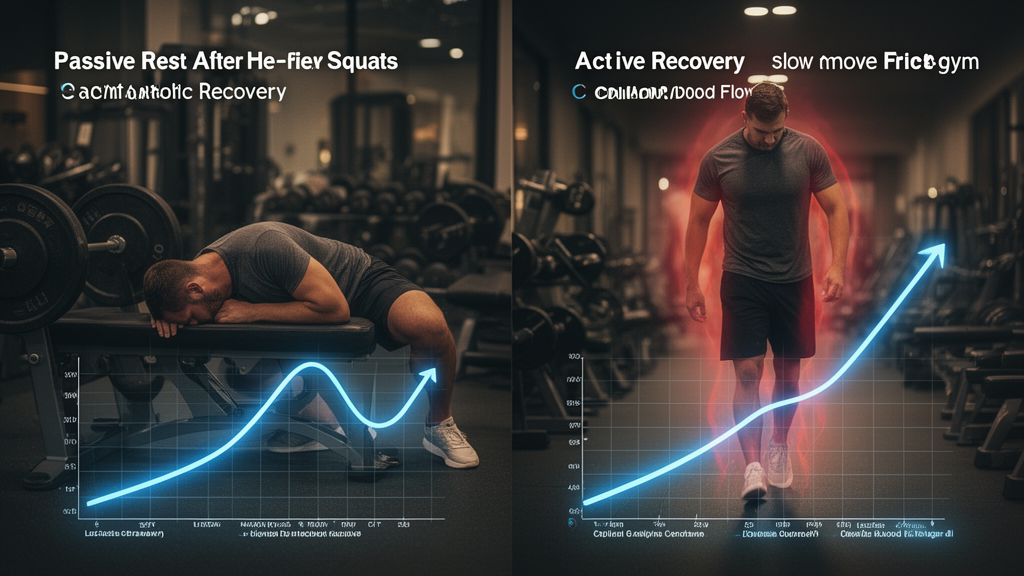
You finish a set of high-rep squats. Your legs are on fire. You collapse onto a bench and sit perfectly still, waiting for the burning to stop. This is a mistake. By sitting still, you are engaging in passive recovery. While it feels comfortable, research on faster lactate clearance active recovery vs passive modes suggests that sitting is actually the slowest way to reset your metabolic clock.
Lactate Shuttling and the Buffering Capacity
Lactate is not just a waste product; it’s a fuel source that must be shuttled out of the muscle and into the bloodstream to be buffered or recycled.
- The Blood Flow Flush: Blood is the vehicle for metabolic clearance. When you sit in a passive state, your peripheral blood flow drops. When you walk in an active state, your “muscle pump” remains engaged, maintaining high-velocity blood flow through the capillaries.
- Increased Oxidation: Active recovery keeps your aerobic system “on,” allowing non-working muscles such as your arms and heart to uptake and oxidize the lactate being produced by your legs.
- The Performance Result: Studies have consistently shown that low-intensity active recovery moving at roughly 30 percent of VO2 max can clear intramuscular hydrogen ions and lactate twice as fast as complete rest. This allows you to start your next set with a significantly more neutral pH environment.
The Lactate Myth
First, let’s clear up a common misconception. Lactate is not the enemy.
Lactate is actually a fuel source. Your body recycles it into glucose. The “burn” you feel is caused by the hydrogen ions known as H+ that accumulate alongside lactate. These ions increase the acidity of your muscle environment.
This acidity inhibits muscle contraction. It is what makes your legs feel like lead.
The Science of Clearance
Your goal between sets is to flush these hydrogen ions out of the muscle and into the bloodstream where they can be buffered.
Blood flow is the flushing mechanism.
Passive Recovery which is sitting
When you sit still, your heart rate drops rapidly. Blood flow to the legs decreases. The “flush” slows down to a trickle. The acidic waste products sit stagnant in your muscle tissue.
Active Recovery which is walking
When you walk slowly or spin lightly on a bike, you keep your muscle pump active. You maintain a slightly elevated heart rate.
Research published in the Journal of Sports Sciences has shown that active recovery can clear blood lactate twice as fast as passive recovery.
The Optimal Intensity
There is a catch. You cannot work too hard during your rest, or you will create more lactate.
The sweet spot is low intensity.
- Heart Rate: Aim for 100 to 120 beats per minute.
- Activity: Slow walking, shaking out the limbs, or very light cycling.
- Feeling: You should be able to breathe exclusively through your nose.
Why It Matters for Hypertrophy
For bodybuilders doing high-volume work, active recovery is a cheat code.
By clearing the acidity faster, you can:
- Maintain higher power output on subsequent sets.
- Reduce the “drop off” in reps, such as getting 10 reps instead of 6 on your third set.
- Increase the total volume load of your workout.
More volume equals more growth.
Don’t Just Sit There
Next time you are deep in the pain cave:
- Stand up.
- Walk a lap around the gym.
- Shake your arms or legs.
Our Rest Timer encourages this behavior. We visualize the lactate clearance curve, reminding you that while the timer is ticking, your body is actively working to reset its chemistry.
Move more. Rest better.
The most practical version of this is simply walking between sets, and the case for and against stretching during rest periods is worth knowing too.