Quick answer: 30 seconds recovers only about half your ATP-PC stores, so it is far too short for strength or hypertrophy work. It is a legitimate tool for endurance and metabolic conditioning, where incomplete recovery is the intended stimulus, and a mistake almost everywhere else.
The Origins: The 30 Second Rest Between Sets Myth
If you walk into any commercial gym, you will see it: lifters doing a set, scrolling on their phone for exactly enough time to catch their breath, usually about 30 seconds, and then going again. This 30 second rest between sets myth has become the default for millions of trainees.
They believe it keeps the “intensity” high and maximizes fat burn. In reality, 30 seconds is the “no man’s land” of recovery periods—it is objectively the worst possible timing for almost every fitness goal.
ATP Half-Life and the Performance Drop-Off
To understand why 30 seconds fails, we must look at the kinetics of Phosphocreatine known as PCr resynthesis. As we detailed in our guide to Creatine Restoration, the “half-life” of your primary strength fuel is roughly 30 seconds.
This means that after 30 seconds of rest, you have recovered exactly 50% of your power.
- Set 1: 100% Force Production capacity.
- Set 2: ~50-60% capacity owing to incomplete fuel recharge.
- Set 3: ~30% capacity.
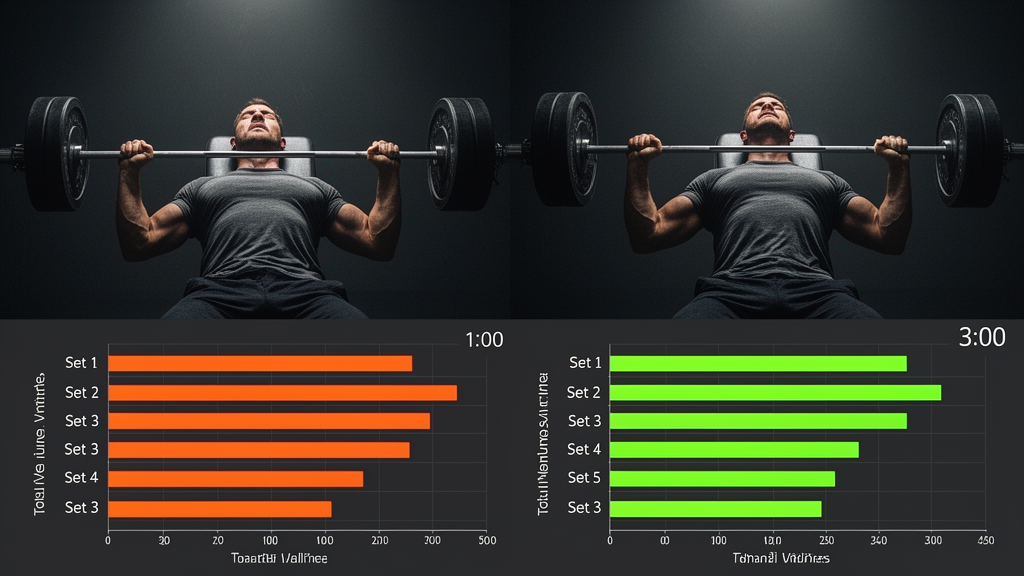
By the third set, you are using a weight so light that it no longer provides a meaningful stimulus for muscle growth also known as hypertrophy or neurological strength. You have turned a resistance training session into a low-grade conditioning session.
Why the Myth Persists
The 30-second rest period became popular in the 1980s and 90s through Circuit Training and “Muscle Magazine” routines.
The goal of those routines was to maximize calorie burn and “toning” for a general audience. They weren’t designed for people who wanted to maximize muscle mass or deadlift 500 pounds.
The Arousal Trap
Lifters love 30-second rest because they feel a massive “pump.” When you rest for such a short time, blood cannot leave the muscle fast enough, making it look and feel bigger temporarily.
However, as we’ve learned, the pump is a secondary driver of growth. Mechanical Tension is the primary driver, and tension requires rest.
Who SHOULD Rest 30 Seconds?
There are only two groups who benefit from 30-second rests:
- Endurance Athletes: If you are a 400m runner or a rower training for “lactate tolerance,” 30-second rests are an excellent tool to teach your body to work through extreme acidity.
- De-conditioned Beginners: If you are just starting out, anything will make you grow. The short rest helps build a baseline of work capacity.
The Better Alternatives
If you are currently resting 30 seconds, you will see immediate gains by switching to:
- Hypertrophy: 90 Seconds. This is enough recovery to keep volume high.
- Strength: 3 Minutes. This is enough recovery to keep intensity high.
Summary
Stop following the “30-second rule” just because everyone else is doing it. Your body is not a circuit training machine. It is a biological system that needs time to recharge.
Don’t guess. Use our Rest Timer to break out of no man’s land.