Conventional Deadlift at a glance
Intermediate- Primary muscles
- Glutes, Hamstrings, Lower back
- Equipment
- Barbell
- Rest for strength
- 3 to 5 min
- Rest for hypertrophy
- 2.5 to 4 min
Also works: Lats, Traps, Quads, Grip
How to perform the conventional deadlift

 1
1Set your position
Stand with the bar over mid-foot, hinge down and grip just outside your knees. Hips higher than knees, shoulders slightly in front of the bar, back flat and lats engaged.
 2
2Push the floor away
Drive through the floor with the hips and shoulders rising together. Keep the bar dragging close to your legs and your back angle constant off the floor.
 3
3Lock out with the hips
Finish by driving the hips forward until you are standing tall with knees and hips extended. Do not lean back or shrug at the top.
Common mistakes
Rounding the lower back
Fix: Set the lats before you pull and brace hard. If your back rounds off the floor, the weight is beyond your current position.
Hips shooting up first
Fix: That converts the pull into a stiff-leg deadlift. Push the floor away with the legs and keep the back angle fixed.
The bar drifting away from the body
Fix: Keep the bar in contact with your legs the whole way. Any gap dramatically increases the load on your lower back.
Hyperextending at lockout
Fix: Finish standing tall with the glutes, not leaning backwards. Leaning back adds spinal stress and no training benefit.
Variations and progressions
Sumo deadlift
Wider stance and more upright torso. Often better for lifters with long femurs or back sensitivity.
Romanian deadlift
A hip hinge from the top with no floor reset, biasing the hamstrings heavily.
Deficit deadlift
Standing on a small platform increases the range and strengthens the pull off the floor.
Trap bar deadlift
Neutral handles and a more upright torso, which reduces lower-back demand considerably.
Quick answer: rest 3 to 5 minutes between working deadlift sets, and up to 5 minutes or more before a heavy single. Deadlifts produce the highest systemic and neural demand of any common lift, so short rest degrades bar speed and back position before it reduces raw strength.
The Science of Scientific Rest Periods Between Deadlift Sets
You finish a heavy set of deadlifts. Your heart is pounding against your chest. You check your phone and see 30 seconds have passed. You grab the bar again. Stop. You are about to fail that lift—not because you are weak, but because you are ignoring the scientific rest periods between deadlift sets required for systemic recovery.
Spinal Loading and Postural Fatigue
The deadlift is unique because it imposes the highest axial spinal loading of any lift. Unlike a bicep curl or even a leg press, the deadlift requires your spinal erectors and core to work as a “rigid pillar” under extreme tension.
- Axial Fatigue: The Central Nervous System or CNS experiences a massive “drain” during a deadlift because it must coordinate the firing of nearly every muscle in the posterior chain simultaneously.
- Postural Failure: Your muscles might have the fuel to lift the weight, but your ability to maintain a neutral spine, which is postural integrity, is governed by the freshness of your nervous system.
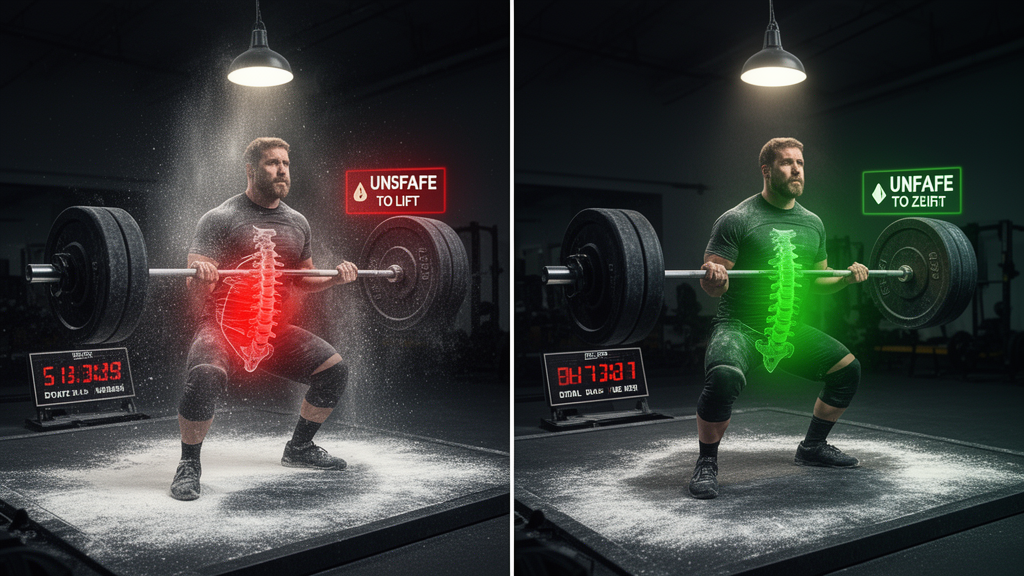
- The 5-Minute Rule: Research on elite powerlifters suggests that for sets exceeding 90% of your 1RM, a full 5 minutes of rest is the minimum required to ensure technical safety on the subsequent set. Anything less is a gamble with your disc health.
Neural Fatigue Explained
Your CNS is the electrical grid of your body. It sends signals to your muscles to contract. When you pull a heavy deadlift, that signal must be incredibly loud and strong.
After a maximal effort, that signal becomes weaker. This is known as neural fatigue. Your muscles might have the fuel, but the spark plug is misfiring.
Research indicates that the CNS takes significantly longer to recover than your metabolic energy systems. While your breath might return in 60 seconds, your neural drive can take 3 to 5 minutes to return to baseline.
The ATP-PC Problem
Your body runs on Adenosine Triphosphate or ATP for short bursts of power. You have a limited pool of this high-octane fuel.
During a heavy set of 1 to 5 reps, you deplete this pool.
- 30 Seconds: You have recovered roughly 50% of your ATP.
- 60 Seconds: You have recovered roughly 85% of your ATP.
- 3 Minutes: You have recovered roughly 98% to 100% of your ATP.
If you pull again after 30 seconds, you are starting your set with a half-empty tank. You will fail reps you should have hit. You will compromise your form. You will risk injury.
Practical Application: Time Your Rest
You need to match your rest period to your training goal.
For Maximal Strength of 1 to 5 reps
Rest: 3 to 5 Minutes
This allows for full CNS recovery and complete ATP replenishment. You will be able to lift the same heavy weight for multiple sets without a significant drop in performance.
For Hypertrophy of 6 to 12 reps
Rest: 2 to 3 Minutes
While shorter rest periods are often preached for muscle growth, the deadlift is an exception. Because of the spinal loading and technical demand, you still need substantial recovery to maintain safe technique. A fatigued lower back is a recipe for a herniated disc.
Don’t Guess. Measure.
Physiological recovery is non-linear. It does not happen in a straight line. It recovers quickly at first and then tapers off.
Our Rest Timer uses a Quadratic Easing Model to visualize this exact biological process. It shows you the rapid initial recovery of your energy systems followed by the slower “topping off” phase.
Stop guessing if you are ready. Watch your recovery curve and lift when your biology is green.
Start the Scientific Rest Timer Now
For heavy pulls, the barbell plate calculator removes the mental math of loading each side to your target.
Comparing lifts? The rest by exercise lookup shows the rest range for every major movement side by side.