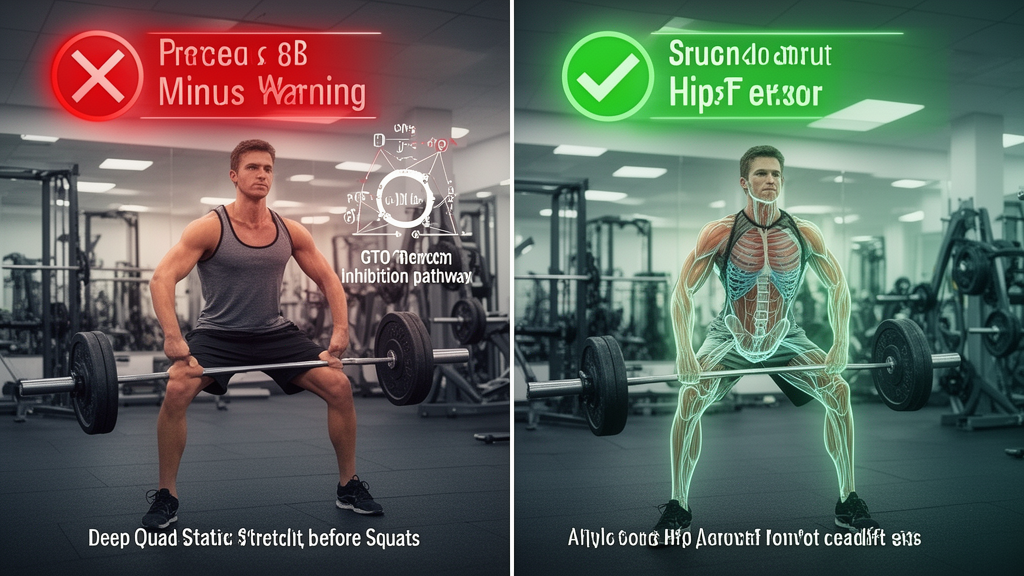
Quick answer: do not statically stretch the muscle you are about to train, as it can temporarily reduce force output for several minutes. Stretching an unrelated or opposing muscle during rest is fine and can be a useful way to use the time. Save longer static stretching for after the session.
Rest periods feel like idle time, and many athletes instinctively fill them with something productive — usually stretching. The logic seems sound: use the downtime to improve flexibility, loosen tight muscles, and arrive at the next set more mobile. In practice, however, the specific type of mobility work you choose during rest can meaningfully help or harm the set that follows.
The key variable is whether you are stretching the muscle group you are about to use, and whether that stretch is static or dynamic.
Static Stretching Reduces Force Output in the Target Muscle
The mechanism responsible for this effect is called autogenic inhibition, mediated by the Golgi tendon organ. The GTO is a sensory receptor embedded in the musculotendinous junction that monitors tension in the muscle-tendon unit. When that tension rises above a threshold — as happens during a sustained static stretch — the GTO fires and inhibits the alpha motor neurons supplying the stretched muscle. The result is a reduction in motor neuron excitability and a measurable decrease in contractile force.
Research consistently shows that static stretching of 30 seconds or longer in a muscle reduces its subsequent force production by approximately 5 to 8 percent, with some studies reporting reductions up to 12 percent depending on stretch duration and intensity. A 5 to 8 percent force reduction in a working muscle represents meaningful lost performance — particularly in near-maximal strength sets where every percentage point matters.
The effect is transient, typically resolving within 10 to 15 minutes. But the duration of a normal rest period — 90 seconds to 3 minutes — is not sufficient for the inhibitory effect to fully clear. If you stretch your quadriceps for 45 seconds and then attempt a heavy squat 90 seconds later, your quad force output will be below baseline.
Agonist vs. Antagonist: The Critical Distinction
The inhibitory effect of static stretching is muscle-specific. Stretching the hip flexor does not inhibit the quadriceps. Stretching the pec does not inhibit the lats. This creates a straightforward practical framework:
Stretching the agonist — the prime mover you are about to use — is contraindicated during rest periods before that set. Stretching the antagonist is generally safe and may actually produce a small facilitatory effect on agonist performance through reciprocal inhibition.
For example: a lifter doing heavy bench press can safely stretch the posterior shoulder and thoracic spine during rest periods. Stretching the pec major or anterior deltoid immediately before pressing is the pattern to avoid.
For more on warm-up practices and set readiness, see warm-up set rest and post-activation potentiation rest windows.
What Is Safe and Productive During Rest
The goal of productive rest period activity should be maintaining body temperature, improving antagonist mobility, and preparing the nervous system for the upcoming set without compromising the prime mover.
Activities that meet these criteria include light dynamic movement such as walking or arm circles, controlled joint mobility work for non-working muscles, antagonist stretching as described above, and breathing work focused on diaphragmatic reset. Moderate aerobic movement — a brief walk around the floor — keeps blood flow elevated and maintains body temperature, both of which support readiness for the next set.
What to Avoid
The pattern most likely to cost you performance is holding a deep static stretch of the muscle group you are about to use. The longer and more intense the stretch, the larger the GTO-mediated inhibition and the longer it takes to resolve.
If your session includes both mobility work and strength sets, the better programming choice is to do static stretching after the session, not during it. Alternatively, position static mobility work for non-working muscle groups, keeping antagonist and unrelated segments as the target.
A Practical Decision Framework for Rest Period Mobility
For athletes who want to use rest time for mobility work, the practical guide is simple. Ask whether the stretch targets the muscle you are about to train. If yes, switch to a dynamic version or target the antagonist instead. If no, the stretch is unlikely to harm your next set and may support long-term mobility. Use a timer from the rest timer presets page to ensure the stretch does not consume so much of your rest that recovery is compromised.