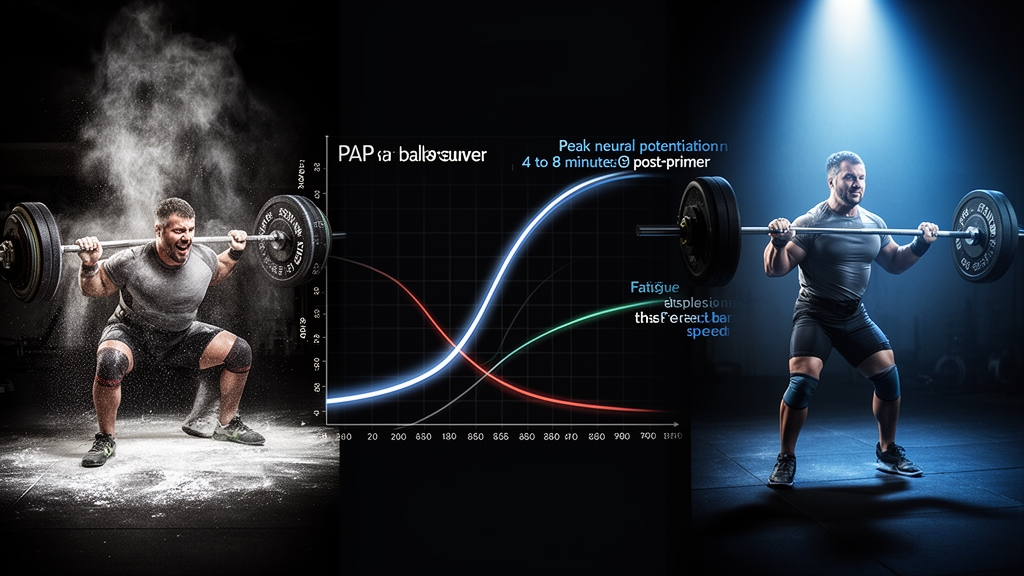
Quick answer: post-activation potentiation needs a rest window of roughly 4 to 8 minutes after the heavy primer to work. Go sooner and fatigue outweighs the potentiation; wait much longer and the effect fades. The exact sweet spot varies with training age and how heavy the primer was.
Post activation potentiation is what coaches are trying to capture when they say a primer set should wake you up, not wear you out.
The problem is that most lifters hear the concept, rush a heavy single, wait an arbitrary amount of time, and call it science.
The real question is simpler: how long should you rest after a primer set so the potentiation remains while the fatigue fades enough to perform?
What Post Activation Potentiation Means in Practice
After a heavy or explosive contraction, the nervous system can become more prepared to recruit force on the next effort. That can improve bar speed, rate of force development, and confidence under the bar.
This effect only matters when two things are true.
- The primer set is heavy or explosive enough to create a real neural signal.
- The following rest period is long enough for fatigue to drop below the potentiation benefit.
That is why the rest window matters more than the buzzword.
The Useful Rest Range
For most lifters, the practical PAP window lives between 3 and 8 minutes after the primer set.
- 3 to 4 minutes often works after a fast, submaximal primer.
- 4 to 6 minutes works well after a heavier single or double.
- 6 to 8 minutes may be better for very strong lifters whose primer set creates more fatigue than it would for an intermediate athlete.
The stronger you are and the heavier the primer set becomes, the more carefully you need to separate potentiation from fatigue.
How to Build a Primer Set Correctly
A good primer set is not a grinder. If the rep is slow, ugly, or emotionally draining, it is not priming anymore. It is just stealing from the top set.
Use a primer set that is:
- technically clean
- fast enough to preserve intent
- heavy enough to create focus
- limited enough that you can still recover fully for the work that follows
This is why the final transition described in warm-up set rest matters so much.
Signs the Rest Window Was Too Short
The primer did not help if:
- your first work rep is slower than normal
- your brace feels unstable
- you feel psychologically flat instead of sharp
- the top set loses one or two expected reps immediately
Those signs mean fatigue was still higher than the potentiation effect.
Signs the Rest Window Was About Right
The rest choice was probably effective if:
- the first rep moves cleanly and aggressively
- setup feels automatic
- the top set reaches planned speed or planned reps
- you feel alert without feeling rushed
That is the sweet spot. The timer should create that feeling, not interfere with it.
How to Use the Rest Timer for PAP
PAP is one of the easiest places to misuse a generic stopwatch. You need a timer that lets you move quickly through early warm-ups, then expand the rest window before the true work begins.
Use this sequence:
- Warm up with shorter rests.
- Run the primer set.
- Move to the 3 minute preset or longer depending on the load.
- Start the top set when you feel sharp and technically settled.
If you need the full workflow, start with the timer quick start. If you need help choosing between the longer presets, review the preset breakdown.
Bottom Line
Post activation potentiation is real, but it is not automatic.
The primer set only helps when the rest window is long enough to let fatigue fall away. That is why most lifters do better with a deliberate 3 to 6 minute pause than with a random guess that feels energetic in the moment.