Quick answer: even mild dehydration of around 2% of body mass reduces strength performance and slows recovery between sets, because lower blood volume means less efficient delivery and metabolite clearance. Drink through the session rather than trying to catch up afterwards.
Dehydration is usually discussed in the context of endurance sport — marathon runners and cyclists managing sweat losses over hours. But resistance training athletes face a hydration challenge that operates on a different timescale: within a single session, modest fluid losses can meaningfully impair the cardiovascular and metabolic recovery that happens between sets. The implication is direct and programmable: when you are dehydrated, your standard rest period is no longer long enough.
The Cardiovascular Demand of Dehydration
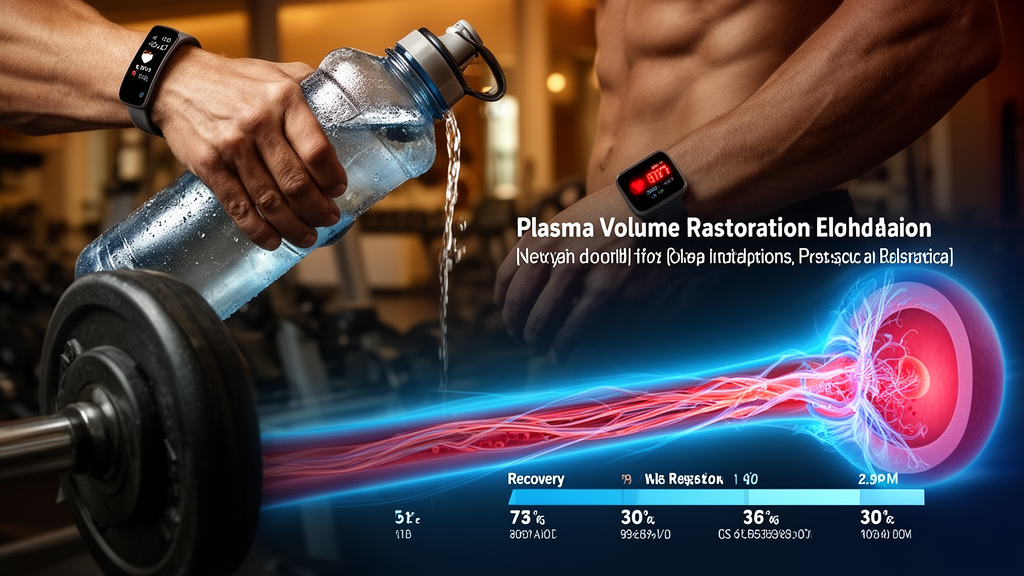
The fundamental mechanism is plasma volume. Blood is roughly 55% plasma — the fluid portion that carries oxygen, glucose, and heat. When sweat losses reduce total body water by even 1 to 2% of bodyweight, plasma volume drops correspondingly. A reduction in plasma volume forces the heart to beat faster to maintain the same cardiac output, a phenomenon known as cardiovascular drift.
In practical terms, this means a set of squats that normally drives heart rate to 150 beats per minute may drive it to 165 beats per minute when the lifter is 2% dehydrated. And because recovery between sets depends heavily on how quickly heart rate returns toward baseline, elevated starting heart rate translates directly into slower inter-set recovery. An athlete who normally needs 90 seconds to recover sufficiently may need 2 minutes or more when mildly dehydrated.
Heart rate recovery dynamics between sets are analyzed further in the article on heart rate recovery between sets.
How Dehydration Affects ATP Resynthesis
Beyond cardiovascular effects, dehydration impairs the aerobic resynthesis of phosphocreatine — the process that restores your primary fuel for maximal strength efforts. Phosphocreatine recovery in the minutes after a set is not purely passive chemistry; it depends on oxygen delivery to the muscle. Oxygen delivery requires adequate blood flow, which is impaired when plasma volume is reduced and cardiac output is compromised.
Research in exercise physiology consistently shows that aerobic capacity decreases measurably at 2% dehydration and that this reduction applies not just to steady-state cardio but to any process that depends on oxidative metabolism — including the PCr resynthesis that powers your next heavy set. The practical consequence is that a 90-second rest interval that achieves 93% phosphocreatine recovery when fully hydrated may achieve only 80 to 85% recovery under 2% dehydration.
Quantifying the Effect on Rest Period Needs
The research suggests that dehydration of 2% bodyweight increases the effective minimum rest by approximately 20 to 30% for equivalent recovery quality. For a 90-second rest preset, that means needing 108 to 117 seconds for the same recovery — a difference that rounds to adding 30 seconds. For a 2-minute rest preset, the equivalent dehydrated rest would be 2 minutes 24 seconds to 2 minutes 36 seconds.
This has a practical programming implication. On days when you arrive at the gym already dehydrated — a common occurrence on hot days or after a poor night of sleep — you should either extend each rest period by 20 to 30 seconds or accept that set quality will be lower than your hydrated baseline.
The compounding effect with dizziness risk after high-effort sets under dehydration is addressed at dizziness after deadlifts.
How Much to Drink
The research-supported approach to training hydration has two components: pre-session status and intra-session replenishment.
Arriving well-hydrated matters more than drinking during the session. The standard recommendation is to ensure urine color is pale yellow before training — not colorless, which indicates overhydration, but clearly diluted. For most adults, this requires consistent fluid intake throughout the day, not a large bolus of water immediately before the session.
During training, sweat rates for resistance training typically range from 500 to 1,000 milliliters per hour depending on session intensity, gym temperature, and individual variation. Replacing roughly 500 to 750 milliliters per hour during training — approximately one to one and a half standard water bottles — keeps most athletes within the 1% dehydration threshold where performance effects are minimal.
Electrolytes matter for sessions longer than 60 to 90 minutes or in hot conditions. Sodium loss through sweat is the primary electrolyte concern and can be addressed with sodium-containing beverages or food alongside water for longer sessions.
Signs of Training Dehydration That Masquerade as Fatigue
Several signs during a training session indicate that dehydration is impairing performance rather than general fatigue or insufficient sleep. Heart rate that seems disproportionately high relative to effort is the most reliable indicator. Headache developing during the session is another common sign. Reduced coordination and grip strength are early markers — and because these also signal CNS fatigue, it is useful to note whether drinking water and resting slightly longer resolves them.
An athlete who consistently “fades” in the second half of sessions despite adequate sleep and nutrition should audit their hydration status before investigating other causes. Improving hydration is among the lowest-cost performance interventions available.
For an overview of how lactate clearance and cardiovascular recovery interact, see lactate clearance and active recovery.
Your environment compounds this, which is why gym temperature changes how long you rest.