Quick answer: women do not need longer rest than men, and often tolerate slightly shorter rest in higher-rep work because they tend to be more fatigue-resistant. Use the same goal-based ranges: 3 to 5 minutes for strength, 60 to 120 seconds for hypertrophy.
The Same Physiology, Different Context
Women and men share the same fundamental recovery biology. Phosphocreatine depletes and restores on the same timeline. Lactate accumulates and clears by the same mechanisms. The ATP-PC system follows the same exponential resynthesis curve in both sexes.
What differs is hormonal context. The fluctuating levels of estrogen and progesterone across the menstrual cycle alter pain perception, glycogen storage efficiency, perceived exertion, and autonomic recovery rate in ways that meaningfully affect how demanding a given set feels — and therefore how long recovery between sets should be.
Women who train with fixed, cycle-blind rest periods leave real performance on the table. Those who learn to read their cycle alongside their training log can train harder in high-hormone phases and protect quality in more demanding ones.
What Estrogen Does for Recovery
Estrogen has a direct and well-documented effect on muscle recovery. It appears to stabilize cell membranes and reduce the extent of exercise-induced muscle damage, particularly during eccentric loading — the lowering phase of any lift. Research consistently shows that women in higher-estrogen phases report lower DOMS scores following identical workouts compared to lower-estrogen phases.
Estrogen also enhances glycogen storage efficiency. More available glycogen means glycolytic energy production is better supported, which sustains higher-rep sets more effectively. This is relevant for sets in the 8 to 15 rep range where the glycolytic system contributes significantly.
The practical effect is that rest periods can be held at standard durations during high-estrogen phases because the recovery mechanism is functioning near its peak capacity.
Follicular Phase Training
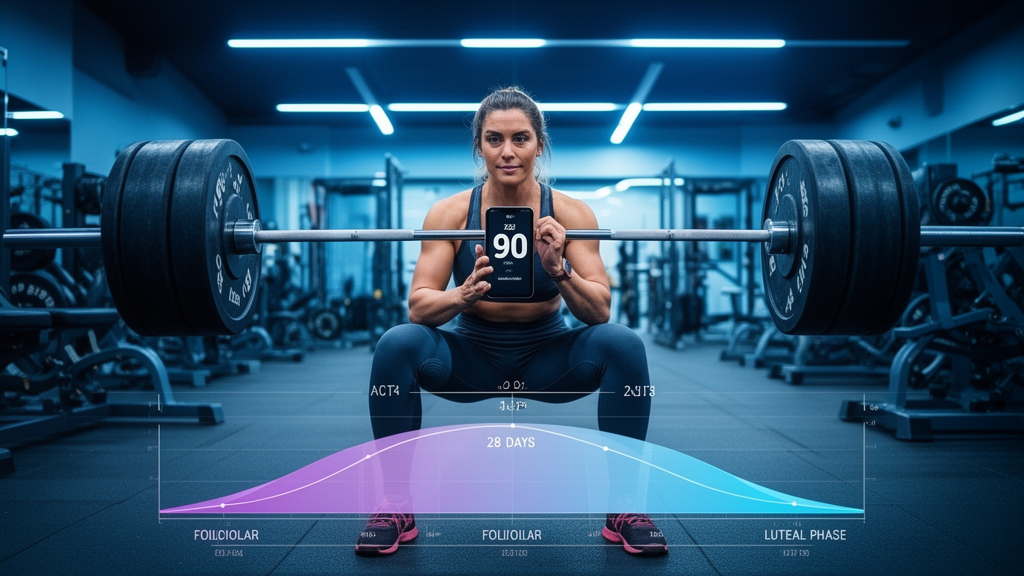
The follicular phase runs from the first day of menstruation through ovulation — roughly days 1 through 14 in a typical 28-day cycle. Estrogen rises steadily across this period, peaking just before ovulation.
During the follicular phase, pain tolerance is higher, perceived exertion for a given load tends to be lower, and glycogen availability improves. This is when most women report feeling their strongest and most energetic in the gym.
Standard rest presets apply without modification during this phase. Use the 90-second preset for hypertrophy work and the 2 to 3 minute preset for heavy compound sets. The body is in an optimal recovery state and will respond well to consistent training stimulus.
Luteal Phase Training
The luteal phase runs from ovulation to the start of the next menstruation — roughly days 15 through 28. Progesterone rises sharply and estrogen drops below its follicular peak after a brief surge.
Elevated progesterone has several effects that influence gym performance. Core body temperature rises slightly. The rate of perceived exertion for identical loads is measurably higher. Glycogen utilization shifts, and some research suggests mild reductions in maximum strength output in the late luteal phase compared to the follicular peak.
None of this means training should be reduced or avoided. It means that identical loads will demand more physiological effort, and rest periods should reflect that. Adding 30 seconds to heavier compound rest intervals during the luteal phase — using the 3-minute preset where you might normally use the 2-minute preset — supports full phosphocreatine restoration and allows the quality of working sets to remain high despite the higher subjective effort.
Hormones and Hypertrophy Rest Needs
A persistent myth in fitness culture holds that women need shorter rest periods because lower testosterone means less mechanical demand. This does not hold up to scrutiny.
Testosterone does contribute to absolute strength levels, but the rest period requirements for hypertrophy are driven primarily by metabolic and neural recovery — not by testosterone concentration. A woman using 70% of her one-rep max in a hypertrophy protocol imposes the same relative demand on her phosphocreatine system as a man using 70% of his. Both need similar recovery time before the next set can be performed with equal quality.
Women who shorten rest based on testosterone comparisons typically sacrifice set quality in later sets — the exact same outcome that limits hypertrophy in any underprepared lifter. The guide on rest periods while cutting covers a related issue for anyone managing volume under a caloric deficit.
Rest Adjustment by Cycle Phase
| Cycle Phase | Hormonal State | Recommended Adjustment |
|---|---|---|
| Menstruation — days 1 to 5 | Estrogen and progesterone low | Use standard presets; reduce load if needed |
| Follicular — days 6 to 13 | Estrogen rising | Standard presets, prime window for PR attempts |
| Ovulation — day 14 | Estrogen peak | Standard presets, strongest week |
| Early luteal — days 15 to 21 | Progesterone rising | Add 15 to 30 s on compound work |
| Late luteal — days 22 to 28 | Progesterone peak, estrogen dropping | Add 30 s on compound work, reduce intensity if needed |
For further context on age-related changes that layer over these cycle effects, the article on rest periods over 40 is directly relevant for women in perimenopause or post-menopause.
The Practical Summary
Cycle-aware training does not require complicated periodization. It requires attention to two variables: which phase you are in, and whether perceived exertion is tracking with expected effort.
On days when a standard load feels unusually hard, add 30 seconds to compound rest intervals. On days when the same load feels easy, use standard presets and consider working at the top end of the rep range. The rest timer presets give you the right intervals — cycle tracking tells you which one to reach for.