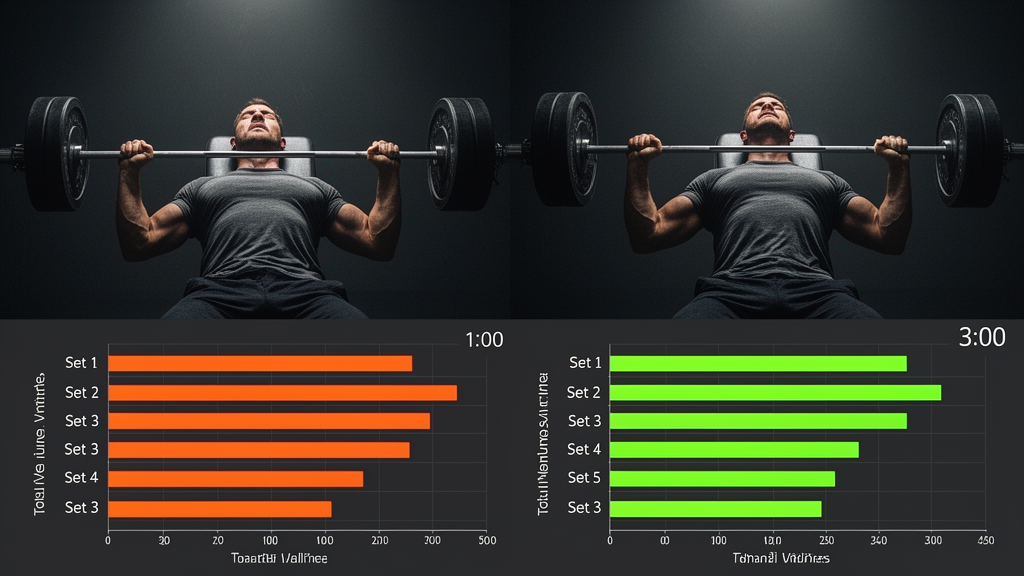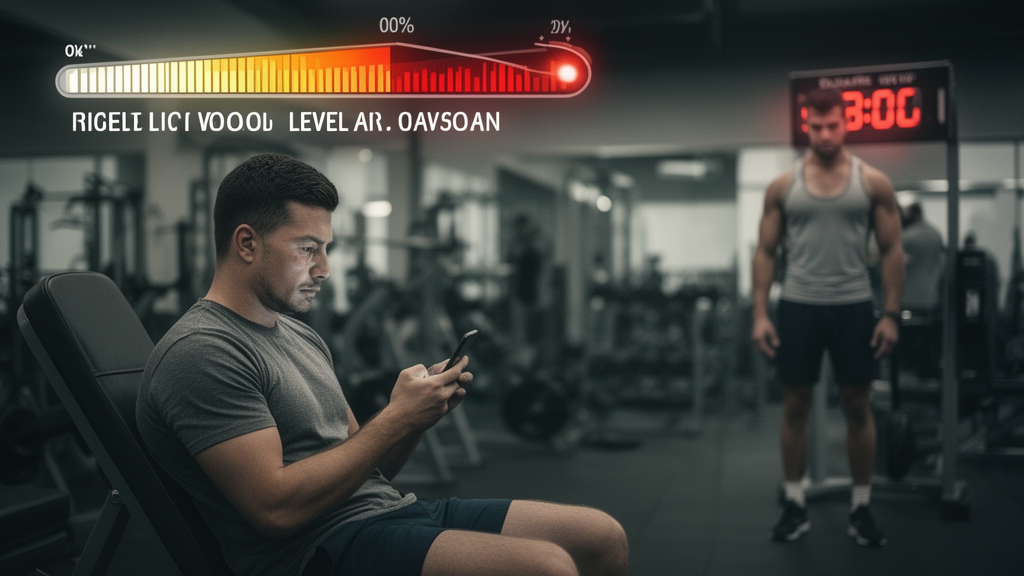
Quick answer: your phone is the main reason planned 90-second rests turn into four minutes. Use it as a timer and nothing else during working sets. If you need it for music or logging, set the timer first so the countdown runs regardless of what the screen pulls you into.
Scrolling Between Sets Costs You Performance
Passive phone scrolling during rest intervals is not neutral. It actively lowers arousal and attentional readiness — two variables that directly determine how much force you can produce on the next set.
This is not a moralizing claim about phone use. It is a physiological observation about how the nervous system responds to passive, low-stimulation input in the minutes between near-maximal efforts. For casual, low-intensity training, the effect is small. For heavy compound strength work, it is measurable and consequential.
The Arousal-Performance Relationship
The Yerkes-Dodson law describes the relationship between arousal — the state of physiological and psychological activation — and performance. At very low arousal, performance suffers because the CNS lacks the activation needed to recruit motor units aggressively and sustain focus through a difficult effort. At very high arousal, performance also suffers because anxiety and hyperactivation disrupt coordination and technique.
Optimal performance for maximal strength work sits in the moderate-to-high arousal range. After a heavy set, arousal naturally stays elevated for several minutes — the sympathetic nervous system remains activated, heart rate is elevated, and attentional focus is heightened.
Passive scrolling through social media or low-stimulation video content occupies the visual system and frontal cortex with diffuse, low-priority processing. This is sufficient to suppress the arousal state — the nervous system interprets passive, low-demand visual input as a signal to shift toward parasympathetic dominance. Heart rate drops faster than it would without the phone. The sense of mental readiness and focus that builds during the rest interval dissipates.
The result is that you arrive at the next heavy set at a lower arousal level than you would have had you simply breathed, focused, and mentally rehearsed.
What Research Shows on Cognitive Distraction and Physical Output
Studies on cognitive distraction and physical performance consistently show that tasks requiring sustained attentional load between exercise bouts reduce subsequent performance on measures of strength and power. The effect is not massive — in research contexts, studies report decreases of 3 to 8% in peak force output following a distracting cognitive task compared to quiet rest.
A 5% reduction in force on a heavy set is not trivial. If your working set at 90% of one-rep max becomes a working set at 85%, the training stimulus changes. Over weeks, that difference accumulates.
The CNS fatigue mechanism is central here. The CNS is not an unlimited resource within a session. Each demand on attentional and cognitive resources draws from a shared pool with the motor system. Passive scrolling does not replenish that pool — it occupies it with low-value processing.
What Feeling Distracted Between Sets Actually Signals
After a heavy squat or deadlift, a common experience is the urge to reach for the phone. This is not simple habit — it reflects a genuine neurological shift. The cognitive system is briefly in a state of reduced capacity following maximal effort, and low-demand passive stimulation feels appealing precisely because it matches the reduced state.
The problem is that giving in to this urge reinforces the parasympathetic shift. What feels like rest is actually deepening the cognitive and arousal valley that the next set needs to climb out of.
The same mechanism is described in the article on sleepy between sets, where post-set drowsiness is explained by adenosine accumulation and CNS activation patterns.
What Is Fine to Do With Your Phone
Not all phone use between sets is equivalent. There is a meaningful difference between passive scrolling and intentional use:
Checking a timer is neutral. It is a single, brief interaction with no attentional capture.
Logging the previous set — entering reps, weight, or RPE — is a focused, brief task that keeps attention in the training context. This is cognitively appropriate.
Listening to music through headphones does not suppress arousal — it can enhance it. Music with high tempo and personally motivating associations raises arousal toward optimal levels for strength performance. The phone itself is not the issue; passive visual consumption is.
What to Do Instead on Heavy Sets
During the rest interval before a near-max compound set, the most effective behaviors are:
Controlled breathing — slow exhales to stabilize heart rate without collapsing arousal. Deliberate diaphragmatic breathing at a moderate rate maintains the sympathetic-parasympathetic balance in the useful range.
Mental rehearsal — visualizing the next set, feeling the grip, the brace, the bar path. This is not mysticism. Motor cortex activation during mental rehearsal primes the same neural pathways used in actual movement.
Cue words — short, specific technical reminders about the one or two technique points most relevant to the next set. Chest up. Elbows in. Drive the floor. These cue words maintain attentional focus in the training context without overstimulating.
The quick start guide for the timer covers how to set up the timer as your primary rest interval tool so that logging and pacing take seconds, leaving the rest of the interval for purposeful preparation rather than scrolling.
The homepage timer can serve as the focal point of the rest interval itself — watching a countdown is a simple, low-demand activity that keeps attention on the training task without triggering the diffuse passive state that scrolling creates.