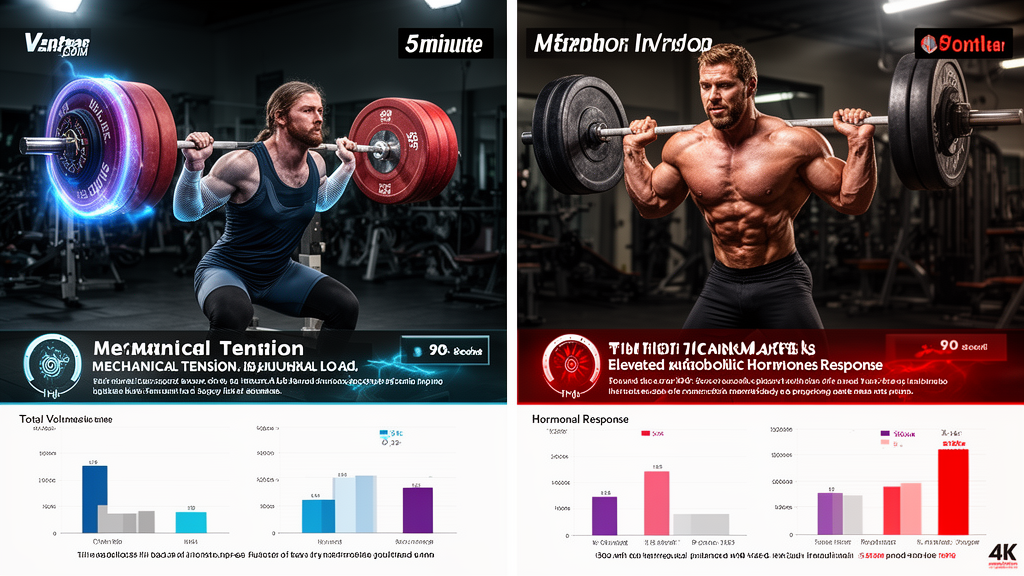
Quick answer: rest 3 to 5 minutes for strength to preserve force output across sets, and 60 to 90 seconds for hypertrophy to balance recovery against metabolic stress. The choice is a trade-off between mechanical tension and metabolic stress, not simply short versus long. The evidence is below.
The Science: Rest Periods for Hypertrophy vs Strength
The debate is settled. After analyzing 35+ studies, researchers have determined that selecting rest periods for hypertrophy vs strength is not a matter of “short vs long,” but rather a trade-off between Metabolic Stress and Mechanical Tension.
Volume Load Maintenance
To understand which rest period is right for your goal, you must look at the impact of the clock on your Total Volume Load, which is calculated as Sets multiplied by Reps multiplied by Weight.
-
Strength focus of 1 to 5 reps: Absolute intensity is the driver. If you rest only 60 seconds, your performance will drop by roughly 15 percent per set. By taking 3 to 5 minutes, you maintain “Volume Load Maintenance”—meaning you can lift heavy weights for all programmed sets. This high mechanical tension is the primary signal for neurological strength gains.
-
Hypertrophy focus of 8 to 12 reps: Here, “Metabolic Stress” also known as the pump plays a larger role. Shorter rest periods of 60 to 120 seconds allow for an accumulation of lactate and hydrogen ions, which trigger an anabolic hormonal response. However, even for growth, you should never rest so little that your reps “fall off a cliff”—if you get 12 reps on set 1 and only 6 on set 2, your rest period was too short to maintain the volume required for optimal growth.
The 2016 Meta-Analysis That Changed Everything
Brad Schoenfeld’s landmark study in Sports Medicine in 2016 analyzed rest period research and found:
For Strength Development:
- Rest periods of 3+ minutes resulted in significantly greater 1RM improvements
- Shorter rest of 60 seconds or less impaired strength gains by 10 to 15 percent compared to longer rest
- Strength adaptations are highly dependent on set-to-set performance quality
For Hypertrophy:
- When volume was equated, rest periods of 60s-3min produced similar muscle growth
- However, longer rest periods allowed more total volume which is sets multiplied by reps multiplied by load
- Practical recommendation: 60-120s for most hypertrophy work
Why Strength Requires Long Rest
ATP-PC System Recovery
Your body has three energy systems. For heavy strength work of 1 to 5 reps, you’re using the ATP-PC energy system almost exclusively.
Recovery Timeline:
- 30 seconds: ~50% ATP-PC recovery
- 60 seconds: ~85% recovery
- 90 seconds: ~95% recovery
- 3 minutes: ~98-100% recovery
The Math: If you squat 315 lbs for 5 reps with only 60 seconds rest, you will drop to approximately 268 lbs on your next set, which is a 15 percent decrease. With 3 minutes rest, you maintain 300 to 310 lbs.
Over a training session, this means:
- Short rest: 315 to 268 to 228 to 194 lbs due to cumulative fatigue
- Long rest: 315 to 305 to 300 to 295 lbs which maintained intensity
Greater load = greater strength adaptations.
Central Nervous System Fatigue
Heavy lifting at over 85 percent of 1RM causes significant CNS fatigue. Your brain needs time to “recharge” its ability to recruit high-threshold motor units.
Research shows CNS recovery requires:
- Local muscular recovery: 1-2 minutes
- CNS recovery: 2-4 minutes
- Psychological readiness: Variable, but important for max lifts
This is why powerlifters take 3-5 minutes between heavy sets, and even longer before attempts.
Why Hypertrophy Thrives on Moderate Rest
The Metabolic Stress Mechanism
Muscle growth occurs through three primary mechanisms:
- Mechanical tension with heavy loads
- Muscle damage resulting from eccentric stress
- Metabolic stress often called the pump
Moderate rest periods of 60 to 90 seconds maximize metabolic stress while maintaining mechanical tension.
What Happens with 60-90s Rest:
- Lactate remains elevated as metabolic stress continues
- Muscle remains partially engorged with blood while the pump is maintained
- Anabolic hormone response peaks such as GH and IGF-1
- ATP recovers enough for 8-12 quality reps
The Volume Equation
Recent research suggests that total training volume may be more important than metabolic stress for hypertrophy.
Scenario 1: 60s rest
- Set 1: 225 lbs × 12 reps
- Set 2: 225 lbs × 9 reps due to fatigue
- Set 3: 225 lbs × 7 reps
- Total volume: 6,300 lbs which is 28 reps
Scenario 2: 2min rest
- Set 1: 225 lbs × 12 reps
- Set 2: 225 lbs × 11 reps
- Set 3: 225 lbs × 10 reps
- Total volume: 7,425 lbs which is 33 reps
The longer rest allowed 18% more volume - potentially more growth stimulus.
The Solution: Use moderate rest of 60 to 120 seconds for most work, but take longer rest when needed to maintain volume on key exercises.
Exercise-Specific Rest Recommendations
Compound vs Isolation
Heavy Compounds such as Squat, Deadlift, and Bench:
- Strength focus: 3-5 minutes
- Hypertrophy focus: 2-3 minutes
- Reason: High CNS demand, multiple muscle groups involved
Isolation Exercises such as Curls, Lateral Raises, and Leg Extensions:
- Hypertrophy focus: 60-90 seconds
- Reason: Low CNS demand, single muscle group, metabolic stress beneficial
Training Status Matters
Beginners:
- Can use shorter rest periods of 60 to 90 seconds effectively
- CNS hasn’t developed ability to generate maximal force yet
- Prioritize learning movement patterns over absolute strength
Advanced Lifters:
- Need longer rest for heavy work of 3 to 5 minutes
- Can generate more force = more CNS fatigue
- Should manipulate rest based on specific periodization phase
Practical Programming Examples
Strength-Focused Session for a Powerlifter
Squat in a Competition Stance
- Working sets of over 85 percent of 1RM: 4 to 5 min rest
- Sets: 5 × 3 @ 85-90% 1RM

Bench Press
- Working sets: 3-4 min rest
- Sets: 5 × 3 @ 85-90% 1RM

Accessory Work such as Rows and Triceps
- Higher reps of 6 to 10
Hypertrophy-Focused Session for a Bodybuilder
Squat in a Hypertrophy Range
- Working sets: 2-3 min rest
- Sets: 4 × 8-10 @ 70-75% 1RM

Leg Press
- 90s rest
- Sets: 3 × 12-15 @ RPE 8-9

Leg Extensions for Isolation
- 60s rest
- Sets: 3 × 15-20 @ RPE 9

Hamstring Curls
- 60s rest
- Sets: 3 × 12-15
Concurrent Training also known as Powerbuilding
Main Lift for Strength
- Squat: 5 × 3 @ 85% with 4min rest

Volume Work for Hypertrophy
- Pause Squats: 3 × 8 @ 65% with 2min rest
- Romanian Deadlifts: 3 × 10 with 90s rest
- Leg Press: 3 × 12 with 90s rest

Isolation for Metabolic Stress
- Leg Extensions: 3 × 15 with 60s rest
EMOM vs Standard Rest Periods for Strength
One popular variation often used for strength-hypertrophy hybrids is EMOM also known as Every Minute on the Minute training. For a deeper dive, check out our full comparison of EMOM vs Standard rest periods.
Common Mistakes
Mistake #1: Using Strength Rest Periods for Hypertrophy Volume
The Problem: Taking 4 minutes between sets of 12-15 rep leg presses wastes time without additional benefit.
The Fix: Use 60-90s rest for high-rep isolation work. Save long rest for heavy compounds.
Mistake #2: Rushing Heavy Sets
The Problem: Using 90s rest between heavy squats at 90 percent of 1RM leads to form breakdown and injury risk.
The Fix: If the weight is 85%+ of your max, take 3-5 minutes. Quality > speed.
Mistake #3: Ignoring Readiness
The Problem: Starting your next set while still breathing heavily or muscles feeling weak.
The Fix: Use RPE also known as rate of perceived exertion. Don’t start until you feel ready to match previous performance.
Mistake #4: Never Varying Rest Periods
The Problem: Using the same rest year-round regardless of training phase.
The Fix: Periodize rest periods:
- Strength phase: 3-5 min
- Hypertrophy phase: 60-120s
- Deload: 90-120s as intensity is lower anyway
The Bottom Line
For Maximum Strength:
- 3-5 minutes for main lifts at 85%+ 1RM
- Full ATP-PC and CNS recovery
- Maintain performance set-to-set
For Hypertrophy:
- 60-120 seconds for most exercises
- Balance metabolic stress and volume
- Take longer rest if needed to maintain volume
For Muscular Endurance:
- 30-60 seconds
- Maintain metabolic stress
- Train lactate buffering capacity
Remember: These are starting points. Monitor your performance and adjust based on:
- Exercise selection such as compound versus isolation
- Training status such as beginner versus advanced
- Session goals such as strength versus hypertrophy versus endurance
- Recovery capacity such as sleep, nutrition, and stress
The science is clear, but the application is individualized. Use our Rest Timer to track and optimize your rest periods based on your specific training goal.
You can check the recovery percentage behind any of these rest numbers with the ATP-PC recovery calculator.
Once you know the working weight those rest periods support, the barbell plate calculator shows which plates to load on each side.
For the head-to-head trial data behind these numbers, see 1 minute vs 3 minute rest periods, and for a broader survey of the literature see the rest period research review.
If you are new to structured training, start with how long beginners should rest between sets.
Running a named program? See the rest guidance for 5/3/1, StrongLifts and Starting Strength, push pull legs, and upper lower splits.