Quick verdict: for pure strength and power, standard rest of 3 to 5 minutes beats EMOM every time, because EMOM caps your recovery at under a minute and force output falls set over set. Use EMOM for conditioning, skill practice, and hypertrophy density work where incomplete recovery is the point. Reserve traditional rest for heavy 1 to 5 rep training. The full comparison is below.
You see it on Instagram. A trainer sets a timer for 10 minutes. Every minute, on the minute, the athlete performs 5 reps. The workout looks intense. Efficient. Modern.
This is EMOM training. And if you use it for strength work, you might be sabotaging your gains.
What Is EMOM
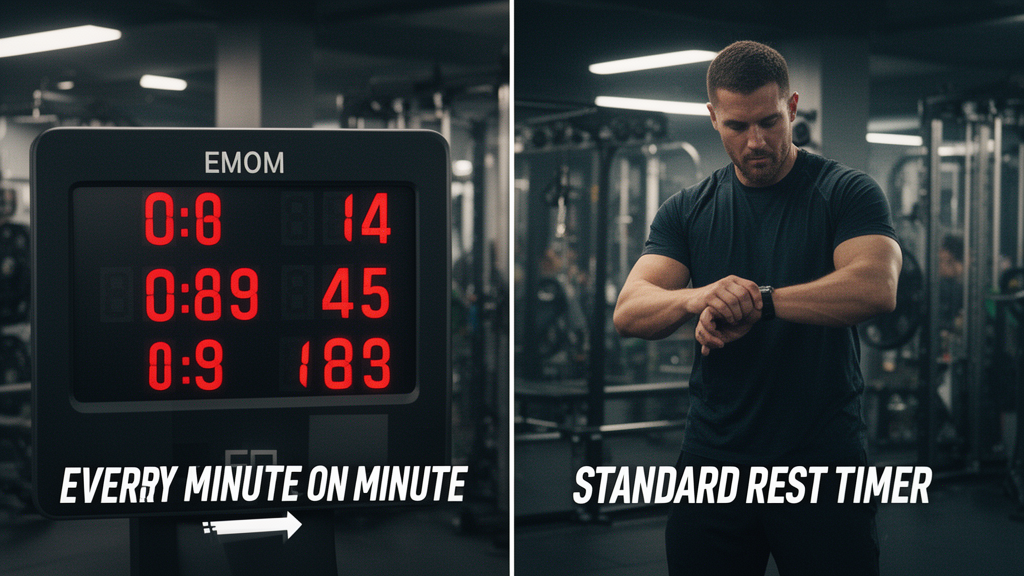
EMOM stands for “Every Minute on the Minute.” The format is simple: you perform a set at the start of every minute. If the set takes 20 seconds, you rest for 40 seconds. If it takes 45 seconds, you rest for 15 seconds.
The Appeal
EMOM creates massive training density. You are working for the entire 10-minute window. There is no “dead time.” It feels productive.
The Reality
EMOM is a metabolic conditioning tool, not a strength-building tool. The short rest forces your cardiovascular system to work hard, but it prevents your muscles from recovering fully.
Standard Rest Periods Defined
Standard rest periods are fixed rest intervals between sets, typically 2 to 5 minutes for strength work.
The Structure
- Perform Set 1.
- Rest for 3 minutes.
- Perform Set 2.
- Rest for 3 minutes.
- Repeat.
The Benefit
Full recovery allows for maximal force production on every set. Your nervous system resets. Your ATP stores replenish. Your technique stays sharp.
The Science: EMOM vs Standard Rest
Energy System Demand
EMOM relies on the glycolytic system even for heavy weights. Because you do not have 3 minutes to clear lactate, hydrogen ions accumulate rapidly. Your muscle pH drops, and force production declines.
Standard rest allows the aerobic system to clear metabolic waste between sets. Your next set starts with a cleaner slate.
Neural Fatigue
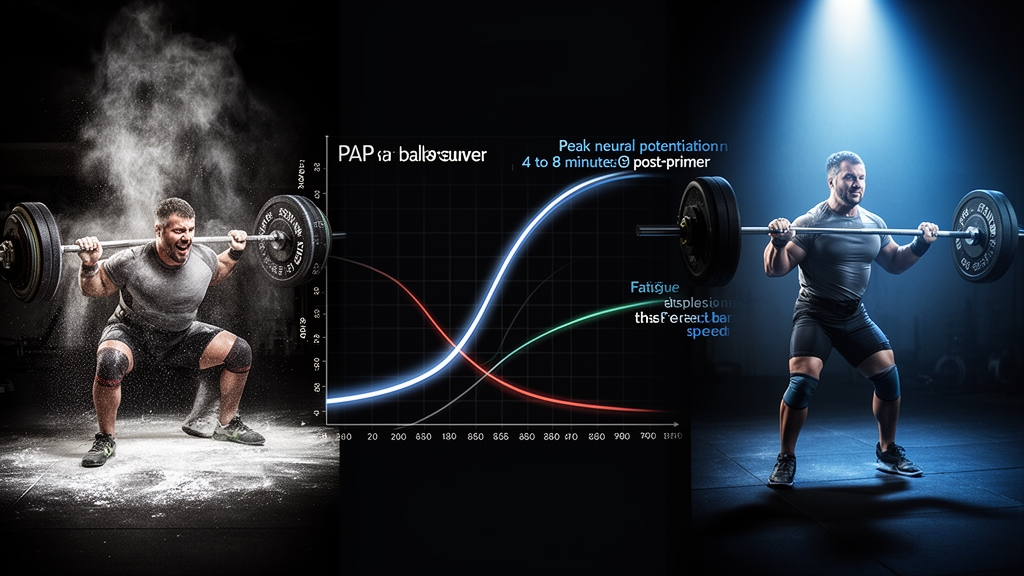
Heavy lifting with short rest creates significant central nervous system fatigue. Your brain struggles to recruit high-threshold motor units when it has not fully recovered from the previous set.
Research shows that EMOM protocols with heavy loads of over 80 percent of 1RM result in 10 to 15% less total volume compared to traditional rest periods due to accumulated fatigue.
EMOM for Speed Work
If you are doing dynamic effort work of 50 to 60 percent of your 1RM for speed, EMOM can work. The weights are light enough that incomplete recovery does not significantly impair force production.
Programming Recommendations
Use EMOM For:
- Accessory work of 3 to 4 exercises
- Light load dynamic effort day
- Conditioning circuits
- Beginner work capacity
Use Standard Rest For:
- Main compound lifts
- Heavy loads above 80% 1RM
- Technical skill work
- Power and Olympic lifts
The Hybrid Approach
Many programs combine both methods.
Week Structure
- Day 1 for Strength: Squats with 3-minute rest.
- Day 2 for Volume: EMOM for accessory work.
- Day 3 for Strength: Deadlifts with 3-minute rest.
- Day 4 for Conditioning: Full EMOM circuit.
This gives you the strength benefits of full recovery while building work capacity with EMOM.
Summary
EMOM and standard rest serve different purposes. EMOM is for density and conditioning. Standard rest is for strength and technique.
Do not use EMOM for your heavy lifts. Save it for accessories and conditioning days. Use our Rest Timer to enforce proper rest periods when you are chasing strength, and switch to EMOM mode when you are chasing conditioning.
You can model this against your own numbers with the EMOM comparator, which shows session time, rep density, and your work-to-rest ratio side by side.
For the AMRAP side of conditioning work, see CrossFit AMRAP rest strategy.