Quick answer: your lactate threshold is the intensity at which lactate starts accumulating faster than you can clear it. Raising it means you can work harder before fatigue sets in, and it also improves how quickly you recover between lifting sets, because clearing metabolites is an aerobic job.
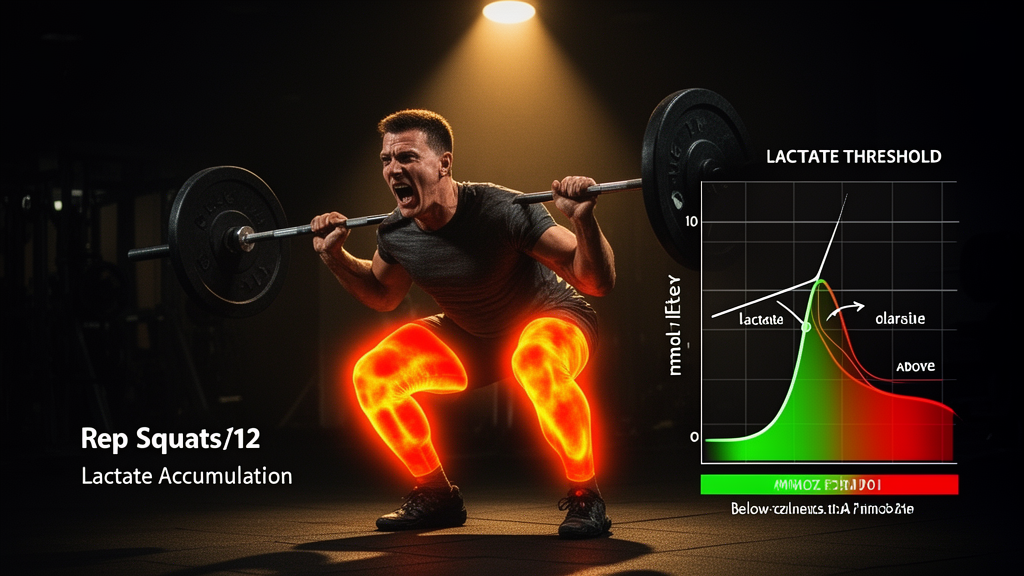
You know the feeling. You’re on rep 12 of a set of squats, or halfway through a brutal CrossFit metcon. Your quads turn to concrete. Your lungs feel like they’re filled with broken glass. You fail the rep, not because you lack the strength, but because your engine just shut down.
For decades, “bro-science” told us that the burning sensation was lactic acid destroying your muscles. They told you to “flush it out.”
They were wrong.
In 2025, we know better. That burn isn’t just pain; it’s a physiological signaling mechanism. And if you understand how to manipulate your Lactate Threshold, you can turn that waste product into high-octane rocket fuel.
Here is the PhD-level breakdown of what’s happening in your blood, and how to use our Rest Timer to hack your work capacity.
The Science: Lactate is Not the Enemy
First, let’s kill a myth: Lactic acid does not exist in your body.
When your body breaks down glucose for energy without enough oxygen, known as anaerobic glycolysis, it produces lactate and hydrogen ions known as H+.
- The Lactate: This is actually an energy source. It gets shuttled to your liver and heart to be recycled into glucose in a process called the Cori Cycle.
- The Hydrogen Ions known as H+: This is the villain. The accumulation of H+ lowers the pH in your muscle, creating an acidic environment.
When that acidity hits a critical level, it inhibits the enzymes responsible for muscle contraction. Your brain screams “STOP” to prevent cellular damage.
The “Bathtub” Analogy
Think of your muscles as a bathtub with the faucet running, creating lactate and H+, while the drain is open for lactate clearance.
- Aerobic Training: The drain is wide open. You clear waste as fast as you make it.
- The Threshold: The faucet is running exactly as fast as the drain can empty. You are at the redline.
- Anaerobic/Failure: The faucet is blasting. The tub overflows. You fail the lift.
Lactate Threshold Training is essentially plumbing work—it widens the drain so you can handle a bigger blast from the faucet without overflowing.
Why Bodybuilders and Powerlifters Need This
“I lift heavy, I don’t do cardio.”
That mindset is why you gas out on accessory work. Improving your lactate threshold improves your Buffering Capacity.
- Higher Volume Tolerance: If you can clear H+ faster, you can perform more reps at the same weight before reaching failure.
- Faster Inter-Set Recovery: A better aerobic engine replenishes ATP faster during rest periods.
- GPP known as General Physical Preparedness: A higher threshold means you can train harder, for longer, with less fatigue accumulation over the training week.
How to Train Your Threshold with the Right Protocols
You don’t need to become a marathon runner. You need to apply specific work-to-rest ratios that force your body to become efficient at clearing acidity.
1. The “Incomplete Rest” Method
This forces your body to clear lactate while under partial fatigue.
- The Work: 4 sets of 8 to 12 reps on a compound movement such as Squats or Rows.
- The Rest: Strict 60 to 90 seconds.
- The Goal: You should be barely recovered enough to hit the next set. If you are fully recovered, the rest was too long. If you fail at rep 4, it was too short.
2. Threshold Intervals or HIIT
Best done on an Assault Bike, Rower, or Sled to spare the joints.
- The Protocol: 4 minutes of work at a “sustainable hardship” which is approximately 85 percent of your maximum heart rate, followed by 2 minutes of active recovery. Repeat 4 times.
- The Science: This keeps you hovering right at that “overflow” point, teaching your body to widen the drain.
Rest Intervals: The Secret Weapon
This is where most athletes mess up. They guess their rest.
If you rest too long during threshold training, your blood pH returns to normal, and you lose the training stimulus. If you rest too little, you simply fail due to mechanical fatigue before metabolic adaptation occurs.
Recovery is not a straight line. It is a curve.
The Quadratic Recovery Model
Your body clears H+ ions rapidly at first, then the rate slows down as you approach baseline. This is a Non-linear Quadratic Decay.
At RestTimerScience.com, we built our tool specifically for this. We don’t just count down seconds; we visualize the recovery curve.
- For Lactate Training: You want to catch the wave before it hits the bottom. You want to start your next set when the timer indicates you are roughly 70-80% recovered, not 100%.
Pro Tip: Use the timer on our homepage and set it to the “Hypertrophy/Endurance” preset. Watch the visualizer—when the bar hits the amber zone, get back under the bar.
The Bottom Line
Don’t fear the burn. Chase it, control it, and use it.
By optimizing your lactate threshold, you turn your body into a hybrid machine capable of heavy loads and high volume. But remember: what gets measured gets managed.
Stop guessing your rest periods. Use a timer that understands physiology.
Start optimizing your recovery now with the Workout Rest Timer.
If you want the practical workflow behind these intervals, start with the timer quick start and use the preset breakdown to decide how much recovery to preserve between threshold efforts.