Quick answer: creatine supplementation raises your muscle phosphocreatine stores by roughly 20 to 40%, giving you a bigger tank rather than a faster refill. In practice that means slightly better performance on shorter rest, but it does not replace resting properly on heavy work.
Creatine monohydrate is the most well-researched performance supplement in existence, and its primary mechanism of action operates directly on the phosphagen energy system. By increasing intramuscular phosphocreatine stores by roughly 10 to 20 percent above baseline, creatine accelerates the rate at which ATP is regenerated during and after high-intensity effort. This raises a logical question: if your phosphocreatine pool refills faster, should your rest periods get shorter?
The answer is nuanced, and the research offers a more modest benefit than most supplement marketing implies.
How Creatine Operates on the Phosphagen System
During a maximal strength set, your muscles depend on the ATP-PC system for the first 10 to 15 seconds of effort. Creatine phosphate donates a phosphate group to adenosine diphosphate, regenerating ATP almost instantaneously. Once that store is depleted, power output drops sharply.
Creatine supplementation works by expanding the size of that phosphocreatine reservoir. You start each set with more stored energy, and the enzymatic machinery responsible for resynthesis — primarily creatine kinase — works at the same rate but has more substrate to act upon. The result is a modest improvement in the speed of PCr resynthesis during rest, alongside a meaningfully larger total capacity.
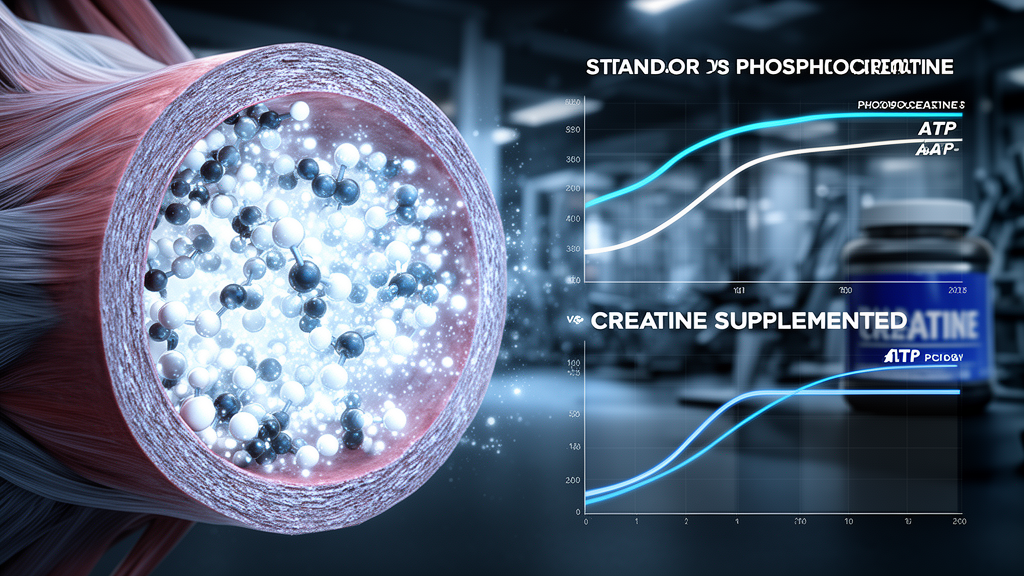
The standard mono-exponential PCr recovery curve shows 50 percent recovery at 30 seconds and 85 percent at 60 seconds for non-supplemented individuals. Creatine supplementation nudges those numbers upward by approximately 5 to 10 percent at any given time point — meaningful, but not transformative.
What the Research Shows
Paul Greenhaff and colleagues at the University of Nottingham conducted some of the earliest controlled work on creatine and repeated high-intensity exercise in the early 1990s. Their findings showed that creatine supplementation improved performance across repeated sprint bouts — with shorter apparent need for recovery between efforts. Subsequent work confirmed that creatine-supplemented subjects could maintain a higher percentage of their first-set performance across multiple sets separated by 1 to 2 minute rest intervals.
Specifically, studies have found that supplemented athletes can produce approximately 5 to 15 percent more total work across a set series with fixed short rest periods. This is functionally equivalent to saying creatine may allow you to use a 90-second rest interval with performance that would otherwise require 2 minutes.
However, the research base is largely built on sprint and jump protocols rather than maximal barbell lifting. Extrapolating the findings requires some caution.
The Practical Implication
The best evidence suggests that creatine may allow rest intervals approximately 20 to 30 seconds shorter for equivalent phosphagen system recovery. If your normal rest for a heavy compound set is 3 minutes, creatine might make 2 minutes 30 seconds sufficient — not 2 minutes, and certainly not 90 seconds.
This is a modest benefit, and it should not be used as justification for dramatically compressing rest. The neural fatigue component of inter-set recovery — which accounts for a substantial portion of total readiness — is not meaningfully altered by creatine. Neurotransmitter depletion and calcium-ion transport sluggishness resolve on their own timeline, independent of PCr stores.
For a detailed breakdown of how ATP-PC recovery kinetics work without supplementation, see ATP Recovery Explained and the ATP-PC system recovery overview.
Who Benefits Most
The athletes most likely to see meaningful rest reduction from creatine are strength-focused athletes doing repeated near-maximal sets with rest intervals already in the 2 to 3 minute range. A powerlifter doing five sets of three at 90 percent of their one-rep max stands to benefit more than a recreational lifter doing three sets of ten.
Endurance and conditioning athletes see minimal benefit from creatine on rest period duration. The aerobic and glycolytic systems that dominate longer-duration work are not substantially improved by phosphocreatine augmentation. For those athletes, rest period duration is governed by lactate clearance and cardiovascular recovery, not PCr resynthesis.
For more on how creatine specifically interacts with phosphocreatine restoration timelines, see Creatine Phosphate Restoration.
Should You Shorten Rest When Taking Creatine?
The answer depends on your training goal. If you are pursuing maximal strength and your rest is already 3 to 5 minutes, creatine provides little practical reason to shorten it — PCr is not the limiting factor at those durations. If you are doing hypertrophy work with 90-second to 2-minute rest and you notice consistent performance across sets, you may find that 60 to 75 seconds becomes viable.
The most pragmatic approach is to test rather than assume. Use a consistent timer, track per-set performance, and see whether shorter rest produces equivalent output. If it does, creatine has earned the reduction. Use the timer at Rest Timer Science to keep your intervals objective and comparable across sessions.
Two other supplement questions come up constantly: caffeine and pre-workout timing and intra-workout nutrition for recovery.