For the elite strength coach or the data-driven athlete, “feeling ready” is not enough. We need numbers. We need kinetics.
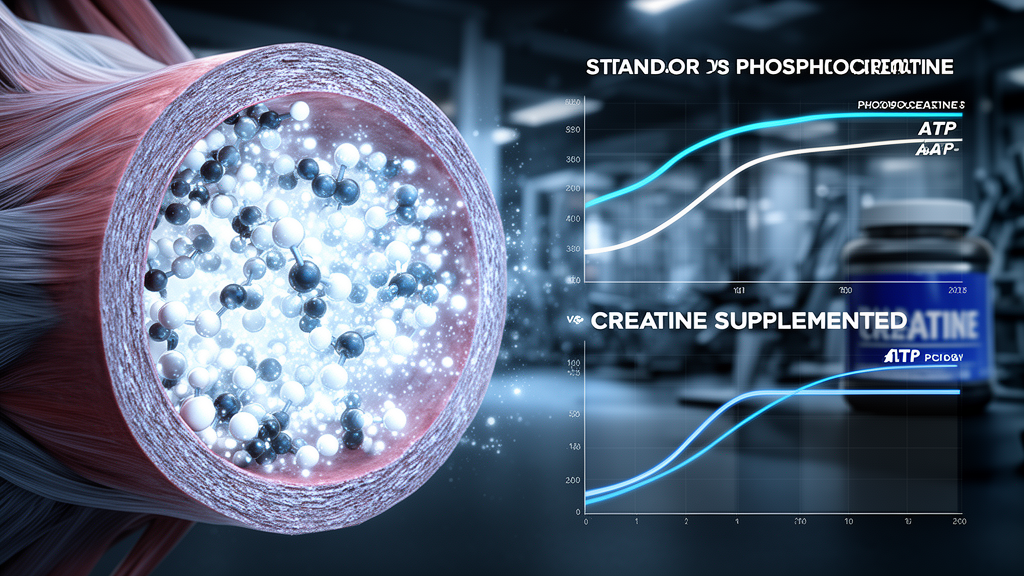
The restoration of Phosphocreatine known as PCr, also known as Creatine Phosphate, is the rate-limiting factor in repeated bouts of high-intensity exercise.
Understanding the kinetics of this reaction allows us to mathematically predict performance drop-off.
The Biochemistry
When you contract a muscle explosively, you hydrolyze Adenosine Triphosphate known as ATP into Adenosine Diphosphate or ADP.
To continue contracting, that ADP must be instantly recharged back into ATP.
- The Reaction:
PCr + ADP + H+ ↔ ATP + Cr - The Catalyst: Creatine Kinase.
This reaction is incredibly fast, but your PCr stores are finite. Once they are depleted, which usually occurs within 10 seconds, power output drops significantly.
The Resynthesis Curve
During the rest interval, the reaction reverses. The mitochondria produce ATP via oxidative phosphorylation, which then donates a phosphate group back to free Creatine to reform PCr.
This process follows a mono-exponential time course.
The Half-Life Rule
The half-life noted as t1/2 of PCr resynthesis is approximately 30 seconds, which ranges from 21 seconds to 57 seconds depending on aerobic fitness.
This gives us a predictable recovery table:
- 1 Half-Life or 30 seconds: 50% Recovered
- 2 Half-Lives or 60 seconds: 75% Recovered
- 3 Half-Lives or 90 seconds: 87.5% Recovered
- 4 Half-Lives or 120 seconds: 93.75% Recovered
- 5 Half-Lives or 150 seconds: 96.8% Recovered
- 6 Half-Lives or 180 seconds: 98.4% Recovered
Implications for Programming
The “98% Rule” for Strength
For maximal strength training, we generally require >98% availability of PCr to ensure Type IIx fibers have adequate fuel.
- Target: 6 Half-Lives.
- Time: 3 minutes minimum.
The “Incomplete Recovery” for Hypertrophy
For hypertrophy, we often aim to begin the next set with incomplete PCr stores, such as 85 percent. This forces the muscle to rely on anaerobic glycolysis earlier in the set, increasing metabolic stress.
- Target: 3 Half-Lives.
- Time: 90 seconds.
The Advanced Edge: Post-Activation Potentiation or PAP
For power athletes, managing creatine phosphate restoration kinetics is only half the battle. You also have to account for Post-Activation Potentiation or PAP.
PAP is the phenomenon where a heavy “primer” lift such as a heavy single squat enhances the performance of a subsequent explosive movement such as a vertical jump or sprint.
However, PAP exists in a delicate balance with fatigue. If you rest too little, fatigue masks the potentiation. If you rest too long, the potentiation dissipates. This creates an optimal post activation potentiation rest window, typically found between 4 and 8 minutes. In this window, PCr is 100% restored, metabolic acidity is cleared, but the nervous system remains in a “heightened” state of readiness.
The Aerobic Connection
Crucially, PCr resynthesis is an oxygen-dependent process. It happens in the mitochondria.
This means your aerobic capacity or VO2 Max directly dictates how fast you recover between sets of heavy lifting. A powerlifter with poor cardiovascular health will have a slower PCr half-life of 50 seconds than a fit athlete of 25 seconds.
If you want to recover faster between sets of squats, do your cardio.
Quantify Your Kinetics
You do not need a lab coat to use this science.
Our Rest Timer algorithms are built on these exact kinetic half-lives. We have digitized the mono-exponential curve. When you use our tool, you are not just watching a clock; you are watching a simulation of your own biochemistry.