Quick answer: in an antagonist superset, rest 30 to 60 seconds between the paired exercises and 90 seconds to 2 minutes after completing the pair. Each muscle effectively gets far longer than that, because it also rests while you work the opposing movement, which is what makes supersets so time-efficient.
You are busy. You have a job, a life, and exactly 45 minutes to train.
The Science: Optimal Rest Periods for Supersets
The traditional “lift, sit on phone for 3 minutes, lift again” method is effective but slow. The Agonist-Antagonist Superset changes the game by using your rest time to train an opposing muscle. But figuring out the rest periods for supersets is more than just rushing from one station to the next; it requires an understanding of how one muscle recovers while its partner works.
Active Recovery vs. Inactive Rest
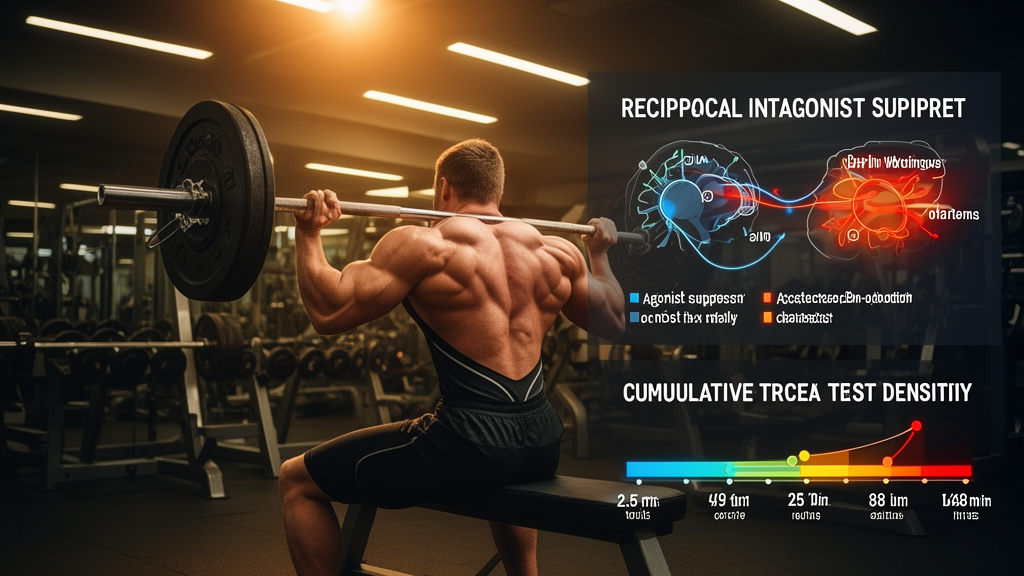
Standard straight sets rely on Inactive Rest—you stand or sit still until your metabolic waste clears. Supersets utilize Active Recovery through a mechanism called Reciprocal Innervation.
- Reciprocal Inhibition: When you contract your back muscles, which is the agonist, your nervous system sends a “relax” signal to your chest muscles, which is the antagonist. This forced relaxation can actually accelerate blood flow and metabolic clearance in the resting muscle compared to sitting perfectly still.
- The Cumulative Window: If you do a set of bench press, rest 30s, do a set of rows, and then rest 90s, your chest has actually rested for over 2.5 minutes before its next set. You have achieved nearly full ATP recovery while doubling your workout density.
- The CNS Constraint: The only limit is your central nervous system. While your muscles recover during the “partner” set, your heart and brain do not. This is why you must avoid supersetting heavy, systemically draining lifts like Squats and Deadlifts.
The Physiology of “Active Recovery”
Your muscles do not recover in a straight line. When you finish a set of Bench Press, your Pectorals are flooded with hydrogen ions and lactate. Your local fuel stores known as ATP are depleted.
If you sit still, your body relies solely on passive blood flow to clear that waste.
However, if you immediately perform a rowing movement for your back, you trigger a mechanism called Reciprocal Innervation.
1. The Neuromuscular Hack
When you contract your back muscles, your nervous system sends an inhibitory signal to your chest muscles to force them to relax. This is biological safety logic. Your body wants to prevent your chest from fighting your back.
This forced relaxation helps your “resting” muscle recover faster than if you were just sitting on a bench.
2. The Blood Flow Shunt
Performing an opposing movement keeps your heart rate elevated. This systemic pressure pumps nutrient-rich blood through your entire upper body. You flush out waste products from the chest while you train the back.
Supersets vs. Rest-Pause: Know the Difference
It is late 2025. We need to be precise with our terminology.
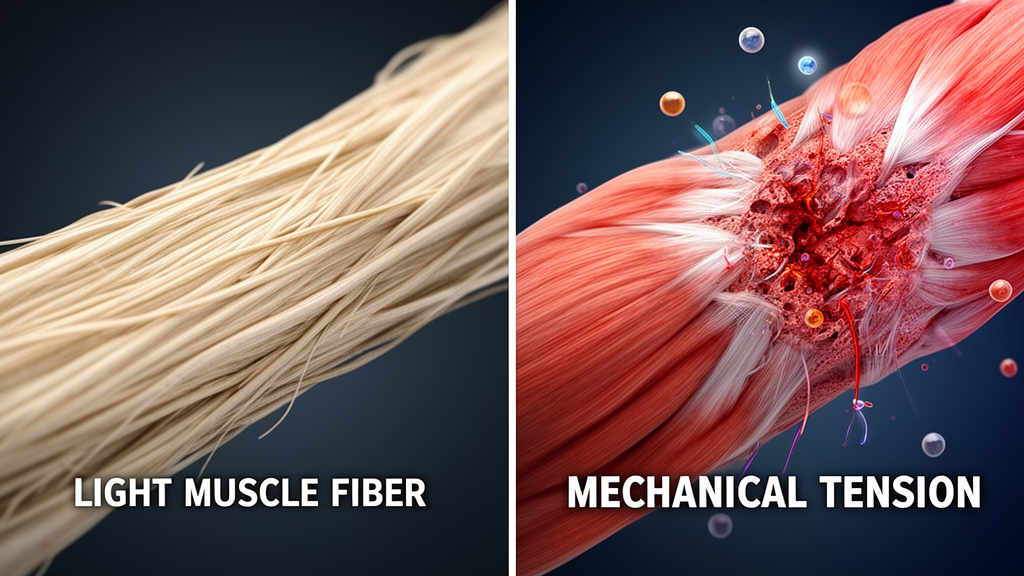
- Rest-Pause: You do a set to failure, rest 20 seconds, and go again with the same exercise. This increases Mechanical Tension and is an intensity technique.
- Supersets: You alternate two different exercises. This increases Training Density and is an efficiency technique.
Use Rest-Pause to break plateaus. Use Supersets to respect your time.
The Perfect Agonist-Antagonist Protocol
To maximize hypertrophy without losing strength, you must follow the 2-Minute Rule.
Research indicates that while one muscle works, the other needs roughly 2 minutes to recharge its ATP batteries completely. But you do not need to sit still for those 2 minutes.
The Routine:
- Exercise A: Dumbbell Incline Bench Press for the chest
- Transition: 30 Seconds Rest while you walk to the next station
- Exercise B: Chest-Supported Row for the back
- True Rest: 90 Seconds Rest as you do nothing
Why this works: By the time you return to the Bench Press, your chest has rested for the 30-second transition, the duration of the Row set which is approximately 45 seconds, and the 90-second true rest. That is over 2.5 minutes of total recovery time for the chest, yet you only spent 90 seconds actually doing nothing.
Nonlinear Recovery and Quadratic Easing
This is where most timers fail you. They count down linearly. But your biology is not linear.
Recovery follows a curve. You recover 50% of your energy in the first 30 seconds. The next 25% takes another minute. The final 25% takes the longest.
Our Rest Timer Science tool uses a Quadratic Easing Model to visualize this. It does not just count down seconds. It shows you your estimated ATP replenishment in real-time.
For supersets, this is critical. You can watch your “Chest Readiness” bar refill while you are destroying your back workout. It takes the guesswork out of the equation.
Practical Examples for Tomorrow
Stop guessing. Use these pairings to save time and build muscle.
Upper Body Push and Pull
- A1: Overhead Barbell Press
- A2: Weighted Chin-Up
- Note: These vertical antagonistic movements decompress the spine and balance shoulder health.
Lower Body Anterior and Posterior
- B1: Leg Extension for Quads
- B2: Seated Leg Curl for Hamstrings
- Note: Avoid supersetting heavy Squats and Deadlifts. The systemic fatigue is too high. Stick to isolation or machine compounds for lower body supersets.
Arms—The Classic
- C1: Tricep Katana Extension
- C2: Bayesian Cable Curl
- Note: The blood volume or pump in the upper arm will be extreme. Ensure you hydrate well.
The Time Math: Supersets vs Straight Sets
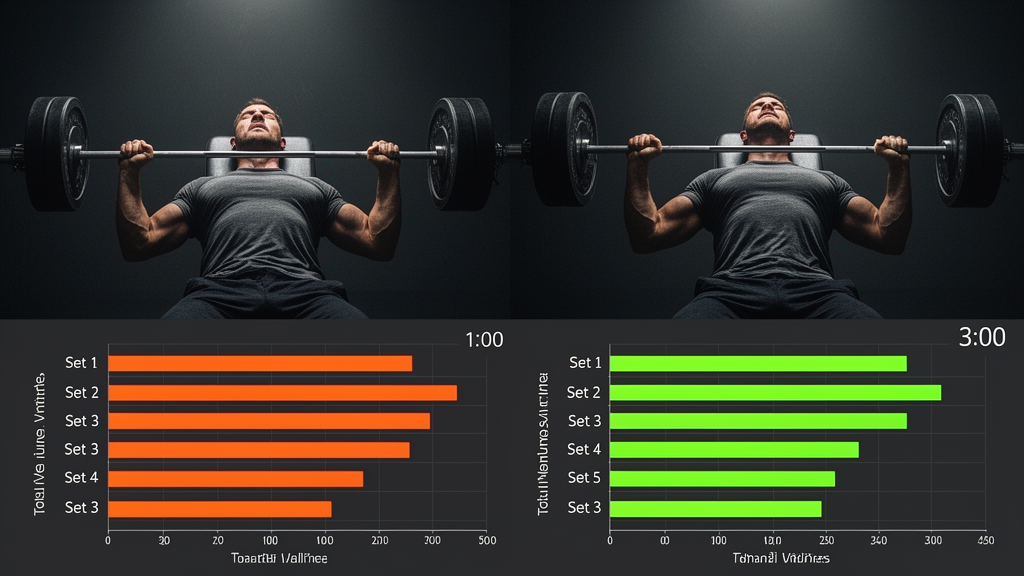
Take an upper-body session of 4 exercises, 3 sets each, targeting 3 minutes of rest.
Straight sets: set, 3 minute rest, set, 3 minute rest, set, 3 minute rest works out to roughly 12 minutes per exercise, so about 48 minutes for four exercises.
Antagonist supersets: run set 1 of exercise A, go straight into set 1 of exercise B, then rest 3 minutes. In that window exercise A has actually rested 4 to 5 minutes, because it also got the time you spent on B. Total for four exercises lands near 28 minutes.
That is roughly 40% less gym time while increasing local rest for each primary muscle. The catch is systemic fatigue: heart rate and central fatigue never return to baseline, which is why pure strength lifters still prefer straight sets for their heaviest work.
Summary
You do not have to choose between a good workout and a fast workout. By leveraging Agonist-Antagonist physiology, you essentially cheat the system. You perform more volume in less time, and your muscles recover faster due to reciprocal inhibition.
Don’t just watch the clock. Watch your recovery curve.
Frequently Asked Questions
1. Can I superset Squats and Deadlifts? No. These movements require massive amounts of Central Nervous System also known as CNS drive. Doing them back-to-back will cause your form to break down. You risk injury. Keep your heavy compound lifts separate and use straight sets with long rest periods.
2. Will I lose strength on the second exercise? Initial studies suggested a slight dip, but recent data shows that once you adapt to the increased metabolic demand, strength remains stable. The neural priming effect of the antagonist muscle can actually boost performance after 2-3 weeks of adaptation.
3. Is this considered cardio? Yes and no. Your heart rate will remain in Zone 2 or Zone 3, which improves your aerobic base. However, the primary goal is still muscular hypertrophy, not cardiovascular endurance. It is a “power endurance” stimulus that gets you shredded while you get strong.
Two related structures are worth knowing: the antagonist superset guide for pairing opposing muscles, and rest times for accessory movements for the isolation work that usually follows.
Comparing lifts? The rest by exercise lookup shows the rest range for every major movement side by side.
For a full comparison of training structures, see straight sets vs supersets vs circuits.
Two movements that pair especially well in a superset each have their own guide: dips and the barbell row.