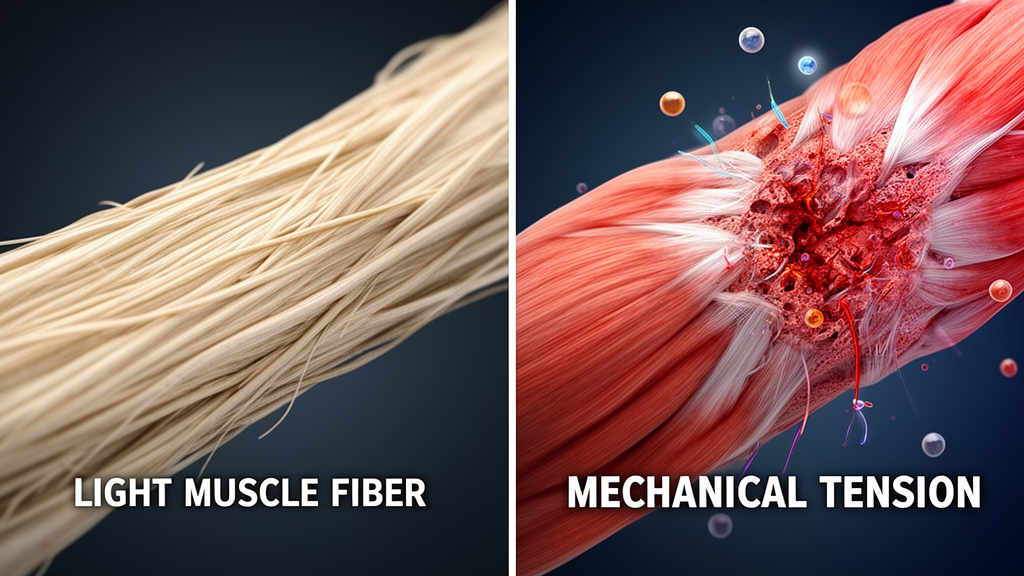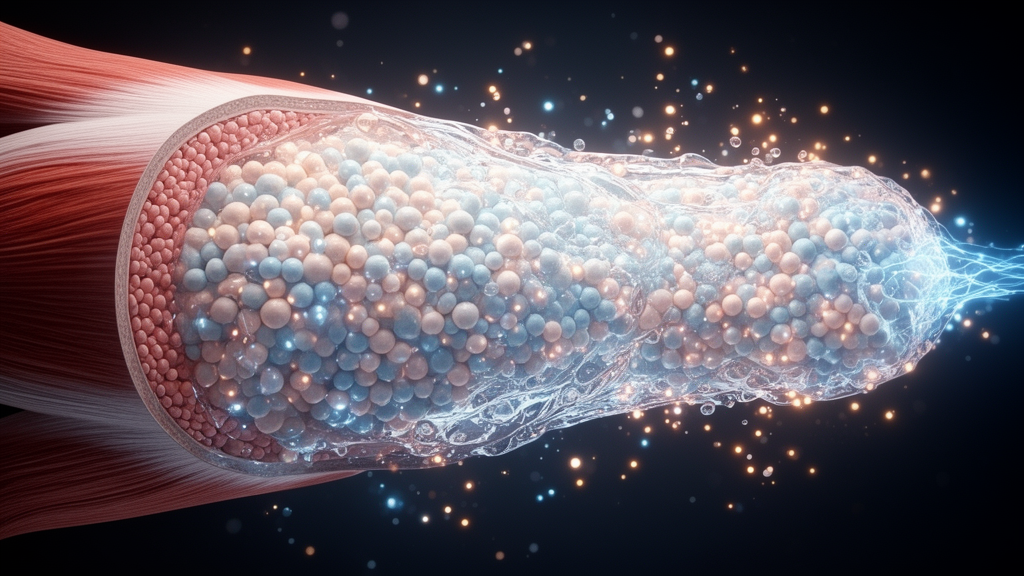
Quick answer: rest 45 to 90 seconds when you are training for the pump and sarcoplasmic adaptation. That window keeps metabolic stress and cell swelling high while still allowing enough energy recovery to complete your target reps. Heavier myofibrillar work needs longer, as covered in strength vs hypertrophy rest.
You finish a set of 12 reps on leg extensions. Your quadriceps are swollen. They look huge. You snap a photo. You post it online.
Bodybuilders call this “sarcoplasmic hypertrophy.” The muscle looks bigger, fuller, and rounder. But is it real muscle growth? And more importantly: how should you rest to maximize it?
What Is Sarcoplasmic Hypertrophy
To understand rest periods for sarcoplasmic hypertrophy, you must first understand what sarcoplasm is.
The Contractile Element
Your muscle fiber contains two main components:
- Myofibrils: The contractile threads that generate force. Growth here is “true” strength.
- Sarcoplasm: The fluid and energy stores surrounding the myofibrils. This includes glycogen, ATP, creatine phosphate, and water.
The Theory
Sarcoplasmic hypertrophy is the enlargement of the sarcoplasm without corresponding growth of the myofibrils. The muscle cell swells with more fluid and energy substrates, making the entire muscle appear larger.
Research suggests that sarcoplasmic hypertrophy accounts for a significant portion of the “beginner gains” and the massive physiques of professional bodybuilders.
The Mechanics of Sarcoplasmic Growth
The sarcoplasm grows in response to metabolic stress and cell swelling. When you create a hypoxic, acidic environment inside the muscle, the body responds by expanding the sarcoplasmic reticulum to handle future demands.
This is why the “pump” matters. It is not just a visual gimmick. It is a signal for growth.
What Triggers Sarcoplasmic Expansion
- Glycogen Supercompensation: Your muscles store more glycogen than usual.
- Cell Swelling: Fluid rushes into the muscle cell due to osmotic pressure.
- Metabolic Byproducts: Lactate and hydrogen ions signal the need for better waste clearance.
The Optimal Rest Period for Sarcoplasmic Growth
Here is the paradox: You need enough rest to continue training, but not so much that the pump dissipates.
The Research
Studies on sarcoplasmic hypertrophy generally recommend:
- Rest Period: 60 to 90 seconds.
- Rep Range: 8 to 15 reps.
- Intensity: 65 to 75% of 1RM.
Why this range?
- 60 seconds is short enough to maintain high lactate levels, triggering metabolic stress.
- 90 seconds allows partial ATP recovery, letting you maintain rep quality for 3 to 4 sets.
- Any shorter, and you cannot complete the reps. Any longer, and the metabolic stress diminishes.
The Sarcoplasmic Workout Structure
The Warm-Up
Do not skimp on the warm-up. Cold muscles do not store glycogen efficiently. Spend 5 to 10 minutes on a bike or rower to raise your core temperature and blood flow.
The Work Sets
- Exercise 1: Compound movement such as the Leg Press. 4 sets of 10 to 12 reps. Rest 90 seconds.
- Exercise 2: Isolation movement such as Leg Extensions. 4 sets of 12 to 15 reps. Rest 60 to 75 seconds.
- Exercise 3: Isolation movement such as Leg Curls. 4 sets of 12 to 15 reps. Rest 60 seconds.
Notice how the rest decreases as the exercise becomes more isolated. The smaller the muscle group, the less rest it needs.
Nutrition for Sarcoplasmic Growth
Rest periods alone are not enough. You need to fuel the sarcoplasm.
Carbohydrate Timing
Eat carbohydrates 1 to 2 hours before training. This ensures your muscle glycogen stores are full before you start depleting them.
Post-Workout Nutrition
Consume carbohydrates and protein within 30 to 60 minutes after training. This triggers insulin, which drives nutrients into the muscle cell, refilling the sarcoplasm.
Sarcoplasmic vs Myofibrillar: Which Is Better
This is the eternal debate in bodybuilding.
Sarcoplasmic Hypertrophy
- Goal: Size and appearance.
- Rest: 60 to 90 seconds.
- Pros: Muscles look full and massive.
- Cons: May not transfer directly to maximal strength.
Myofibrillar Hypertrophy
- Goal: Strength and density.
- Rest: 3 to 5 minutes.
- Pros: True functional strength gains.
- Cons: Muscles may appear smaller even at the same weight.
The Hybrid Approach
Most advanced bodybuilders cycle between both styles. Use longer rest for compound movements and shorter rest for isolation work. This gives you the best of both worlds.
Summary
If you want to maximize sarcoplasmic hypertrophy:
- Rest 60 to 90 seconds between sets.
- Stay in the 8 to 15 rep range.
- Chase the pump. The swelling is the growth signal.
- Eat carbohydrates to fuel the sarcoplasm.
Use our Rest Timer to lock in those 60 to 90 second rest periods. When the pump is high, do not let it fade. Get back under the bar and grow.