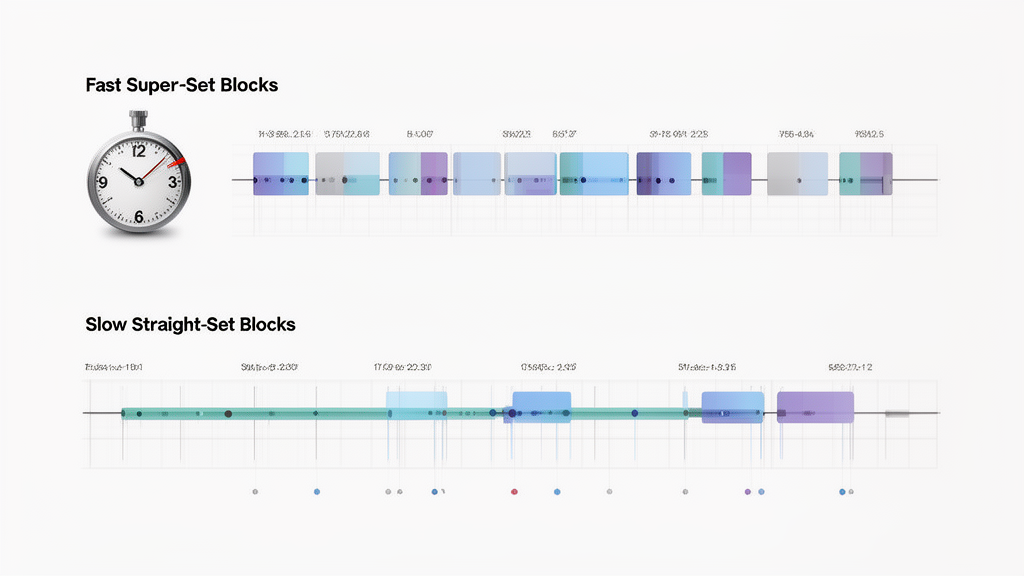
The Math: Supersets vs Straight Sets for Time Efficiency
Option 2 is a Superset. It is the go-to tool for busy lifters, but many wonder about the actual data behind supersets vs straight sets for time efficiency.
While everyone knows supersets are “faster,” understanding the mathematical breakdown helps you decide if the trade-off in intensity is worth the seconds saved.
Mathematical Breakdown of Time Saved
Let’s look at a standard upper body session consisting of 4 exercises, 3 sets each, with a target of 3 minutes of rest for optimal recovery.
1. Straight Sets Method
- Set 1 of Exercise A plus 3m Rest + Set 2 + 3m Rest + Set 3 + 3m Rest = approximately 12 minutes per exercise.
2. Antagonist Superset Method by Pairing A and B
- Set 1 of Exercise A -> 0m Rest -> Set 1 of Exercise B -> 3m Rest.
- In this window, Exercise A has actually rested for about 4 to 5 minutes, which is the time it took to do Exercise B plus the official 3m rest.
- Total for 4 exercises: ~28 minutes.
The Result: You have saved 40% of your total gym time while actually increasing the local rest for the primary muscle groups. However, your Systemic Fatigue regarding heart rate and CNS never returns to baseline, which is why pure strength lifters still prefer straight sets.
The Science of Recovery
The reason supersets work—specifically Antagonist Supersets (Push/Pull)—is that one muscle group can recover while the other is working. Our complete guide on antagonist supersets and reciprocal inhibition covers the science of this technique in detail.
When you do a set of Rows, your Bench Press muscles such as chest and triceps are essentially “resting.”
- The Benefit: You get double the work density without significantly increasing your rest need between sets.
- The Catch: Your Cardiovascular and Central Nervous Systems do not get to rest.
Even if your chest is rested, your heart is still pounding and your brain is still taxed from the Rows. This is the “Systemic Fatigue” limit.
Performance Comparison
Research generally shows that for Hypertrophy, there is no significant difference between supersets and straight sets, provided the total volume and intensity are the same.
However, for Maximal Strength or 1RM, straight sets are still superior.
- You are training for absolute strength of 1 to 3 reps.
- You are performing high-risk compound movements such as Squats and Deadlifts.
- You have unlimited time.
Use Supersets When:
- You are training for muscle growth of 8 to 15 reps.
- You are doing accessory work.
- You are short on time.
- You want to improve your cardiovascular conditioning while lifting.
Summary
Supersets are a powerful tool, but they are not magic. They trade a small amount of peak force production for a massive gain in time efficiency. For 90% of lifters, that is a trade worth making.