Overhead Press at a glance
Intermediate- Primary muscles
- Shoulders
- Equipment
- Barbell
- Rest for strength
- 3 to 5 min
- Rest for hypertrophy
- 90s to 2 min
Also works: Triceps, Upper chest, Core
How to perform the overhead press

 1
1Set the front rack
Hold the bar at your front shoulders with elbows slightly ahead of it and a grip just outside shoulder width. Squeeze your glutes and brace your core hard.
 2
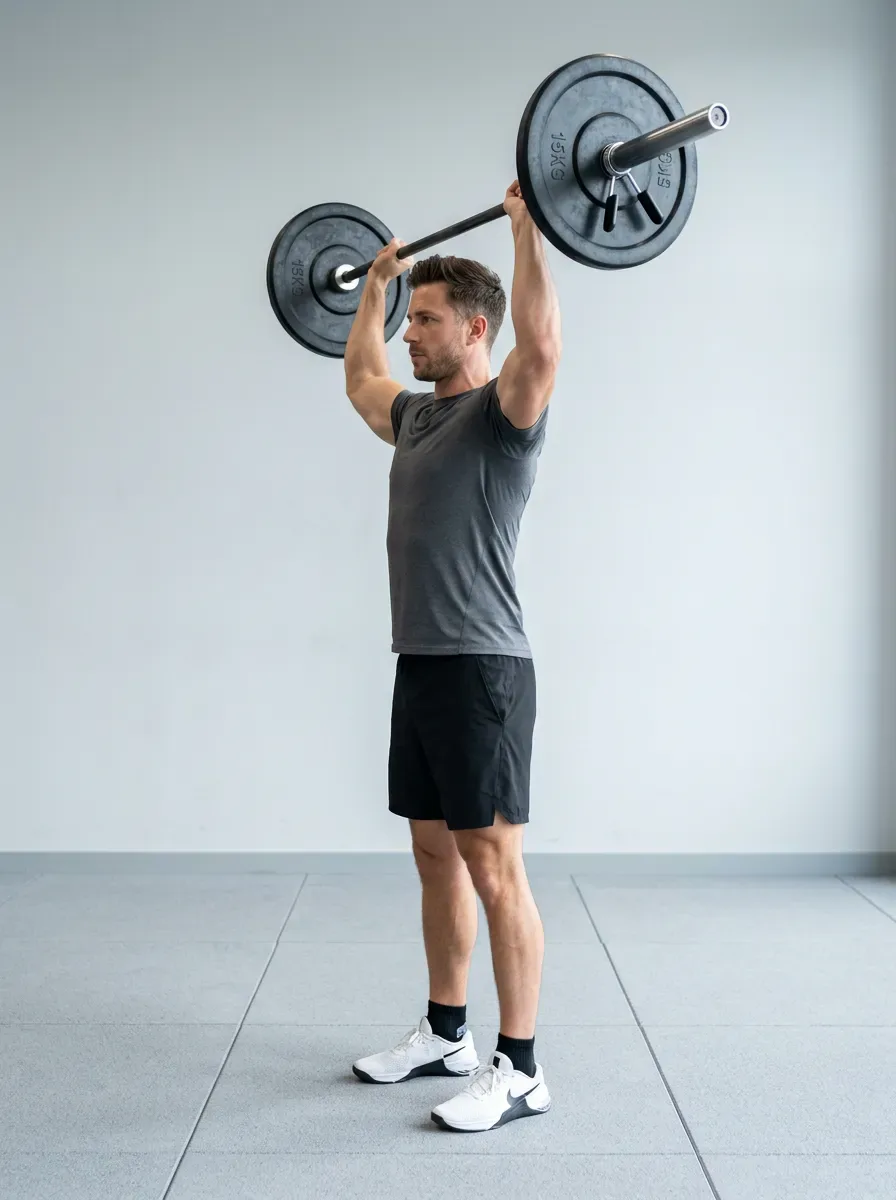
2Press around the face
Push the bar up and slightly back, moving your head out of the way as it passes. Keep the ribs down so the press does not become a lean-back.
 3
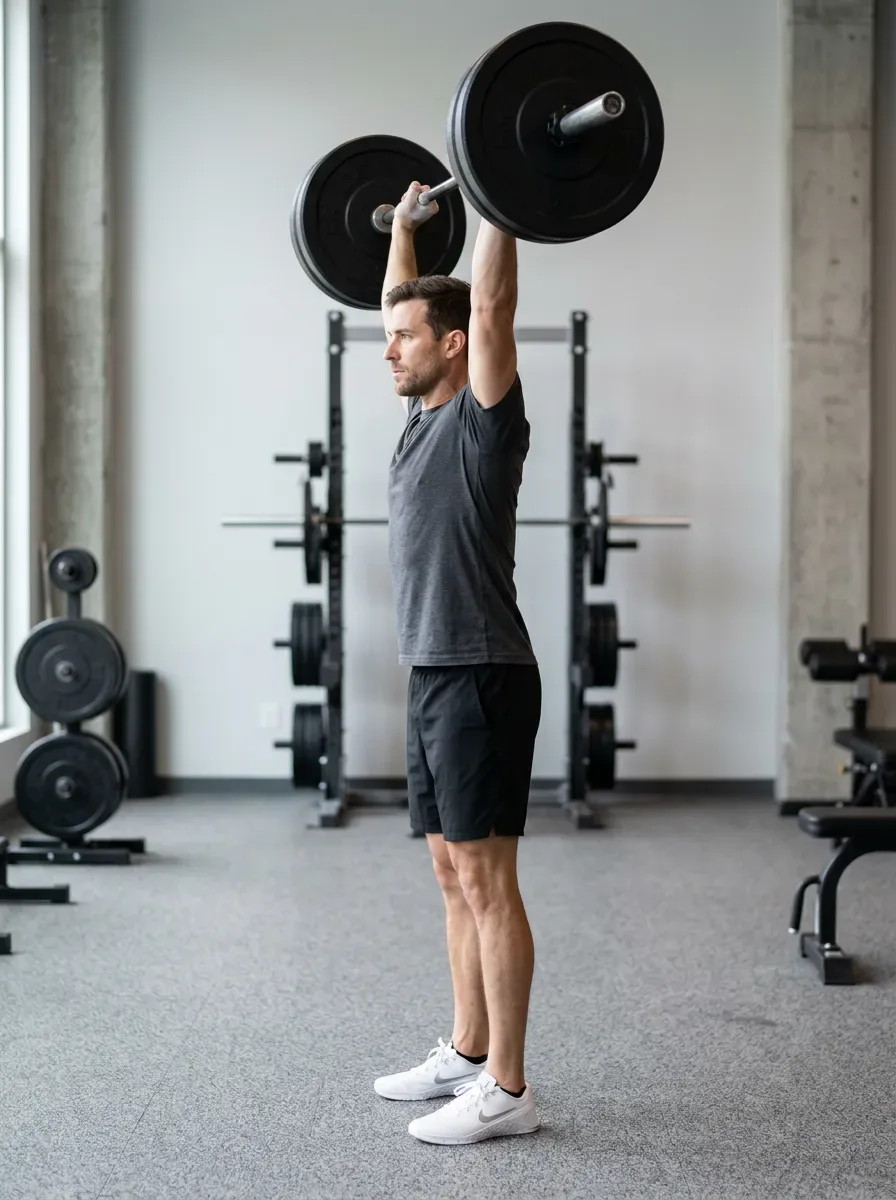
3Finish with the bar overhead
Lock out with the bar over the middle of your head and your biceps beside your ears. Shrug the shoulders up slightly at the top to finish the movement.
Common mistakes
Leaning back to press
Fix: Squeeze the glutes and keep the ribs down. If you have to arch to move the bar, the weight is too heavy.
Pressing around the face instead of through
Fix: Move your head back as the bar passes, then bring it through under the bar at lockout so the load finishes over your midline.
Starting from a loose rack
Fix: Set the bar on the shoulders with the elbows just ahead of it. A loose start wastes the strongest part of the press.
Not finishing the lockout
Fix: Shrug at the top so the bar sits over the middle of your head. A short lockout leaves the shoulder in a weaker position.
Variations and progressions
Push press
A small leg drive lets you handle more load and overload the lockout.
Seated press
Removes leg drive entirely and forces strict shoulder work.
Dumbbell shoulder press
Independent arms and a more natural shoulder path.
Z press
Seated on the floor with legs straight. Brutal on core and postural control.
Quick answer: rest 3 to 5 minutes between heavy overhead press sets and 90 seconds to 2 minutes for hypertrophy work. The shoulders are small relative to the demand and the whole trunk works to stabilize, so performance falls off faster here than on the bench.
The Overhead Press also known as OHP is the most humbling lift in the gym. You can add 10 pounds to your deadlift in a month, but adding 5 pounds to your press can take a year.
Why? Because the OHP relies on small muscle groups—the anterior deltoids and the triceps—that fatigue rapidly.
If you are stalling, the answer is rarely “train harder.” The answer is usually “rest longer.”
The “Micro-Muscle” Problem: Why Stalls Happen
Unlike the squat, which uses massive leg muscles that hold huge stores of glycogen, the shoulders are relatively small. They have smaller fuel tanks.
When you push a heavy weight overhead, you drain these small tanks almost instantly. This is the primary reason why rest intervals for overhead press stalls must be managed more strictly than almost any other lift.
1. The Tricep Factor
Your triceps are the “weakest link” in the overhead press. While your shoulders might have some fuel left, the triceps—which are responsible for that final lockout—often fail much earlier. If you rush your rest, you’re not just fighting gravity; you’re fighting a tricep that hasn’t fully cleared its metabolic waste.
2. Technical Precision and “The Float”
The OHP is a balancing act. If the bar drifts even one inch forward of your center of gravity, the lift is failed. This precision requires a high level of neural freshness. A fatigued nervous system cannot make the micro-adjustments needed to keep the bar path vertical.
The 3 to 5 Minute Rule for Breaking Stalls
If you are stuck at the same weight for more than two sessions, your first adjustment should be your rest window. For most lifters, 3 minutes is the absolute minimum, but moving to 5 minutes of rest can often result in an immediate break in the plateau.
Strategy: The “Cluster” Approach
If you are truly stuck, try Cluster Sets.
Instead of doing 3 sets of 5 reps, break it down:
- Perform 1 rep.
- Rest 15 seconds.
- Perform 1 rep.
- Rest 15 seconds.
- Repeat for 5 total reps.
This allows for partial ATP replenishment during the set. It allows you to lift a weight for 5 reps that you could normally only lift for 3.
Volume vs. Intensity
If your goal is Boulder Shoulders for Hypertrophy:
- Rest 60-90 seconds.
- Use dumbbells.
- Accept that you will use lighter weights. The goal is metabolic stress.
If your goal is Strength with the Barbell OHP:
- Rest 3-5 minutes.
- Treat every rep like a 1-rep max.
- Never rush.
What a Bad Rest Choice Looks Like
If your first set feels crisp and the second feels like a different exercise, rest was probably the problem. Watch for these signs:
- The first rep moves slowly even though the weight is familiar.
- Your ribcage flares because the brace is not fully reset.
- Lockout takes much longer than the press off the shoulders.
- Rep count drops by two or more without a programming reason.
That pattern means you started the next set before ATP and neural readiness caught up.
A Better Session Structure
Phase 1, warm up quickly. Use the approach in warm-up set rest. Move briskly through light weights to build rhythm without draining the session.
Phase 2, extend rest for working sets. Once the set matters, move to the 2 or 3 minute preset. It feels long if you are used to bro-style pacing, but it preserves the quality that makes progression possible.
Phase 3, shorten rest for accessories. After the main press work, shoulder raises, dumbbell presses, and triceps work can use shorter countdowns with a hypertrophy bias.
The Verdict
The Overhead Press does not forgive impatience. It demands respect.
Next time you press, use our Rest Timer. Set it to 3 minutes. Do not touch the bar until it beeps. You might find that the “plateau” was just fatigue in disguise.
Comparing lifts? The rest by exercise lookup shows the rest range for every major movement side by side.